Celebrating our Maternity Support Workers: 24 November 2026
On Maternity Support Worker Celebration Day, we're saying thank you to our Maternity Support Workers and recognising the important part they play in caring for women, babies and families throughout pregnancy, birth and the first days of parenthood.
Working alongside midwives and the wider maternity team, our Maternity Support Workers provide practical care, reassurance and support to families throughout pregnancy, birth and the early days of parenthood.
From supporting feeding and carrying out observations to helping families feel comfortable, informed and cared for, they are an important part of our maternity services.
Maternity Support Worker Celebration Day is an opportunity to recognise the skills, care and support these colleagues bring to maternity services and the difference they make to families, as well as to the midwives and wider teams they work alongside.
A big thank you to all our Maternity Support Workers at Gloucestershire Hospitals.
The role of the Maternity Support Worker during your pregnancy
Maternity Support Workers (MSWs) provide personal care to women, birthing people and babies. MSWs support midwives to provide care in pregnancy, around the time of birth and in the postnatal period.
12 weeks
At your 12 week scan, you will see an MSW who will take bloods, undertake your height and weight, complete your screening and discuss pregnancy vaccinations.
16 weeks
If you opt for quadruple screening, an MSW will be running this clinic.
16–42 weeks
If you attend any antenatal clinic, day assessment or maternity assessment clinics at the hospitals, an MSW will undertake carbon monoxide readings, take bloods, test urine, take your blood pressure, help book your caesarean section or induction, take swabs and generally support you throughout your appointment.
If you live in Gloucester, you may have an MSW attached to your community midwifery team. They will take carbon monoxide readings, take bloods, test urine, take blood pressure readings, facilitate your antenatal education sessions and discuss pregnancy vaccinations.
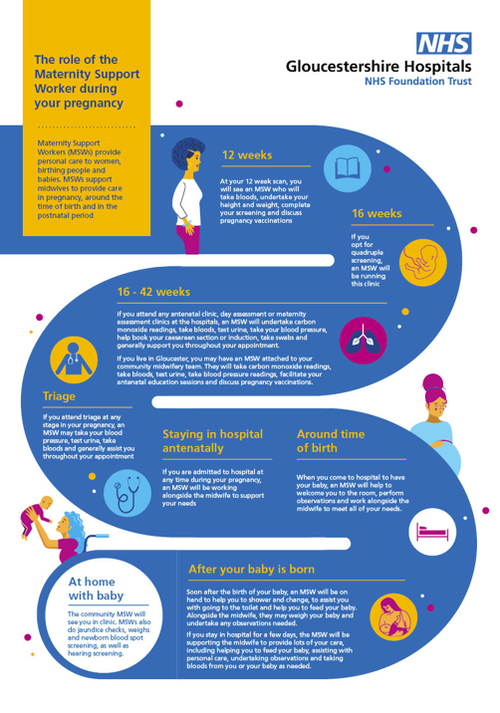
Triage
If you attend triage at any stage in your pregnancy, an MSW may take your blood pressure, test urine, take bloods and generally assist you throughout your appointment.
Staying in hospital antenatally
If you are admitted to hospital at any time during your pregnancy, an MSW will be working alongside the midwife to support your needs.
Around time of birth
When you come to hospital to have your baby, an MSW will help to welcome you to the room, perform observations and work alongside the midwife to meet all of your needs.
After your baby is born
Soon after the birth of your baby, an MSW will be on hand to help you to shower and change, to assist you with going to the toilet and help you to feed your baby. Alongside the midwife, they may weigh your baby and undertake any observations needed.
If you stay in hospital for a few days, the MSW will be supporting the midwife to provide lots of your care, including helping you to feed your baby, assisting with personal care, undertaking observations and taking bloods from you or your baby as needed.
At home with your baby
The community MSW will see you in clinic. MSWs also do jaundice checks, weighs and newborn blood spot screening, as well as hearing screening.