Rabies (lyssavirus)
Microbiology
Notes
Suspected case or potential exposure to Rabies
- The information given here is intended for use by healthcare professionals.
- Please see Lab Tests Online-UK for more general advice, links and background
- For a suspected case of Rabies or potential exposure to Rabies, please contact the UKHSA Rabies and Immunoglobulin Service (RIgS) for a risk assessment on 0330 128 1020 (7 days per week, 9:30am to 5pm) or 020 8200 4400 (out of hours). . RIgS will determine whether post exposure treatment (PET) is required and provide guidance on its appropriate use. For further information, see UKHSA guidelines on managing rabies post-exposure prophylaxis
Information:
- The disease is absent from land mammals in the UK but has been detected at a low prevalence in certain species of bats in the UK.
- The virus is present in saliva and infection is usually spread by the bite of an infected animal but even licks from an infected animal may transmit the disease.
- The incubation period is most often one to three months however may be several months or even years, particularly if bites are distal and peripheral.
Please ensure that the following information is available before calling RIgS to facilitate full and timely risk assessment:
- District and country visited, including travel dates
- Type of animal exposure (which animal, lick or bite, site of exposure), and dates of exposure
- Current health of the animal if known
- Vaccination history
- Immunosuppression status
- For a suspected symptomatic case, provide relevant clinical details, including symptoms and date of onset
If a potential case of rabies is suspected, please notify the duty Consultant Microbiologist following discussion with RIgS.
Post vaccination
- Individuals who are at continuous risk should have their antibody levels tested every six months. Reinforcing doses of vaccine should be given if serology indicates that antibody levels are below a protective antibody titre of at least 0.5 IU/mL (WHO 2010).
- For those at frequent risk, a single reinforcing dose of vaccine should be given one year after the primary course has been completed. Further booster doses should then be given at three to five years.
- Post vaccination samples can be sent at any time.
Sample requirements
If a case of rabies is suspected, the Clinical Microbiologist must be contacted urgently BEFORE any samples are taken for analysis in Pathology. Antemortem diagnosis of rabies requires several specimens (eg, saliva, skin biopsy, serum, CSF) and multiple testing modalities, since the sensitivity of any single test is limited. It is often not possible to confirm a suspected diagnosis of rabies by laboratory tests ante mortem; postmortem specimens are usually required to confirm the diagnosis.
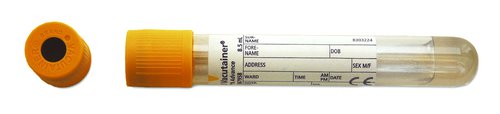
Serum - paired samples not required
8.5ml of blood taken into a plain gel tube
Required information
Suspected case/exposure
- Essential information include district and country visited including travel dates, type of animal exposure (which animal, lick or bite, site of exposure), and dates of exposure, current health of animal if known
- Vaccination history
- For a suspected symptomatic case give relevant clinical details, including symptoms and date of onset
Post vaccination
- Occupational hazard (e.g. UK bat handler)
Storage/transport
Store at fridge temperature
Transport as soon as possible at ambient temperature
Turnaround time
Sent to a National Reference Centre
Up to 21 days for post vaccination testing