We use cookies to provide you with a better service. Carry on browsing if you’re happy with this or read more about our cookie policy and privacy policy.
Changes to Cheltenham A&E during BMA Industrial Action 17 - 22 December
This page gives you information about having a bone marrow biopsy, what the procedure involves and answers the frequently asked questions.
Thanks to donations, a new specialist technology is benefitting local cancer patients for the first time in Gloucestershire.
The triscaphoid joint is located within the wrist joint, and involves the scaphoid, trapezium and trapezoid bones.
This page covers some of the most important things that have been discussed with you during admission. The information on this page aims to help you through the first few weeks following diagnosis and also gives you advice and guidance to help you to make the safe transition from hospital to home.
This page gives you information about the Direct Antibody Test (DAT) and why it might be used. You will be able to refer to this page alongside any other information you have been given by your healthcare team. If after reading this page you have any questions, please do not hesitate to ask a member of the team.
In Gloucestershire, the biggest and most highly anticipated immunisation campaign in history will begin at a hospital hub in Gloucester today before the scope of the programme is widened via an innovative community vaccination model.
This page has been designed to help you exercise your sphincter muscles. Sphincter exercises can help you to reduce leakage from the bowel. These exercises are also beneficial for patients who are due to have a colostomy or ileostomy (stoma) reversal operation. When done correctly these exercises can build up and strengthen the muscles to help you to hold both wind and stool in the back passage.
This page is to inform you about how some of your medicines will be supplied. The medicine(s) shown on this page will be delivered to you by a clinical homecare provider. The hospital clinical team uses a homecare provider to dispense and deliver certain medicines. At your hospital appointment your medication will be reviewed and a prescription written. You will not need to collect the medication from the pharmacy department in the hospital or get a prescription from your GP. Instead, your prescription will be sent directly to the homecare provider specified. Within a few days of receiving your prescription the homecare provider will call you to arrange a time and location for the delivery of your medication (and any other items required to use the medicine such as syringes). In addition to this page, you may be sent an information pack from the homecare provider. The pack will give you more details about the service they offer and provide you with the contact details of the homecare Patient Services department. This will enable you to contact them if you have any concerns or if you no longer wish to use this service.
The information on this page is a guide for patients and carers about vitrectomy surgery.
This page gives you information about having laser treatment on your eye(s). Your eyes have been diagnosed with, or maybe likely to develop problems with the circulation of the fluid within the eye. This can lead to a painful type of glaucoma called angle-closure glaucoma. Laser treatment needs to be performed on your eye to help the fluid pass more freely within your eye.
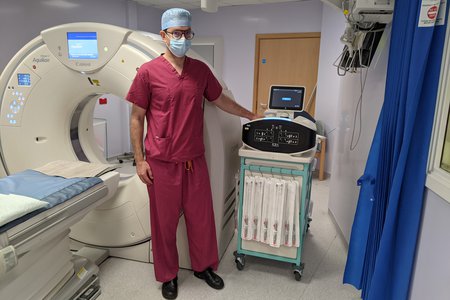
This page gives you information about having a Computed Tomography (CT) scan of the body. It explains how the procedure is carried out and some of possible complications.
This pagegives you information about doxycycline and its use, including side effects. It has been suggested that you take doxycycline because it is considered an important part of the treatment for many types of hair and scalp disorders including Lichen planopilaris and Follicultius decalvans.
We're committed to improving our digital capabilities to provide the best possible care for our patients. This digital strategy outlines a clear plan to achieve this goal between 2019 and 2024.
This tool helps to identify medications potentially negatively affecting cognitive function, including those causing dizziness and drowsiness, using the Anticholinergic Effect on Cognition (AEC) scale, which also defines the extent of this effect.
A lower limb cast is a hard covering that stabilises and immobilises either your ankle or knee and sometimes both at the same time.
This page provides you with information about the condition Retinopathy of Prematurity (ROP). It is designed for parents/carers of babies on the Neonatal Unit who are examined and found to have this condition.
You have been asked to attend Same Day Emergency Care (SDEC) or the Ambulatory Emergency Care (AEC) departments because you may have an infection in your legs called cellulitis. This page contains information about lower limb cellulitis and how it will be treated.
Pancreatic cancer can be found anywhere in your pancreas and may not cause symptoms until it is advanced or has spread to other parts of the body.
Keyhole surgery to remove the kidney This page contains information for patients having laparoscopic nephrectomy (keyhole surgery to remove the kidney) or nephroureterectomy (surgery to remove the kidney and ureter).
This page gives you information about what to expect before and after a port-a-cath is inserted. It also lists the benefits and possible risks of having the device inserted.