REACCT
Re-Education and Carbohydrate Counting Training This page contains all of the information that will be discussed during the REACCT (Re-Education and Carbohydrate Counting Training) course. REACCT offers advice and support to people with type 1 diabetes who are looking to improve their knowledge and understanding of their condition. We share the latest advice about diabetes management while teaching you how to count carbohydrates, and how this relates to your insulin doses. Each course is made up of 3 informal group sessions with each session being about 3 hours long. The sessions are spread over 2 to 3 months. The sessions are held at both Gloucestershire Royal and Cheltenham General Hospitals.
On this page
-
Target glucose levels
-
What affects your glucose levels?
-
Insulin regimes and profiles
-
Types of insulins used
-
Adjusting insulin doses
-
Injection technique
-
Hypoglycaemia (hypos)
-
Hyperglycaemia
-
Illness and ketones
-
Sick day rules
-
Annual review
-
Driving
-
Travel
-
Diabetes and pregnancy
-
Carbohydrate counting and bolus advisors
-
Contact information
-
Further information
Target glucose levels
Over time, you will develop the skills to be able to manage your glucose levels. The guidance is to aim for a glucose level between 3.9 and 10mmol/L for more than 70% of the time and less than 3.9mmol/L for less than 4% of the time. This can be measured using a glucose sensor.
You may have more specific glucose targets to work towards at different parts of the day that sit between 3.9 to 10mmol/L range.
As a guide, the target glucose levels for adults are:
- on waking: between 5 and 7 mmol/L
- before meals and at other times of the day: between 4 and 7 mmol/L
- 90 minutes after meals: between 5 and 9 mmol/L Targets are personalised based on your individual circumstances such as daily activities, aspirations, likelihood of complications and history of hypoglycaemia.
Within the PDF below, you can use the box on page 4 to record your personal targets.
HbA1c (glycosylated haemoglobin)
The HbA1c gives a representation of glucose levels during the last 3 months.
Levels are now expressed in mmol/mol rather than a percentage. The recommended HbA1c for people with diabetes is between 48 and 53 mmol/mol, to prevent the risk of long-term complications.
What affects your glucose levels?
Many different factors influence your glucose levels at any one time. This is why you may sometimes find your glucose levels vary. The most common factors to impact your glucose levels are:
- Food
- Insulin
- Injection sites
- Mental or physical stress
- Mobility
- Activity and exercise
- Illness
- Heat/cold
- Alcohol
- Medications
- Hormones
- Hand washing pre-test
Insulin regimes and profiles
Whenever you take your insulin, you should check the following:
- Expiry date - do not use the insulin if it is out of date
- Temperature - Insulin that is in use should be stored at room temperature for up to 28 days. Insulin that has been out of the fridge for more than 28 days may become ‘unstable’ and should be thrown away.
- Insulin not in use should be stored in the fridge
- Do not freeze insulin
You should carry out these checks to make sure the insulin will be effective in managing your glucose levels.
Types of insulins used
Long acting analogue insulin (basal)
- Lantus®
- Toujeo®
- Abasaglar®
- Semglee®
- Tresiba®
Basal (long acting) insulin
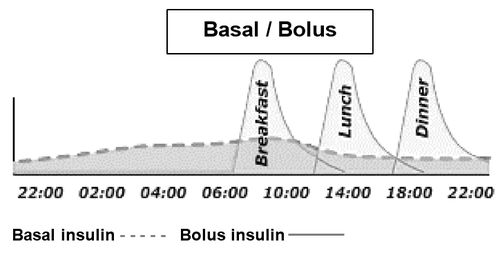
Basal insulins are what we call background insulins. They can work anywhere between 18 and 42 hours and are usually injected once or twice a day.
The majority of basal insulins should be taken at the same time every 24 hours Basal insulins are not meal related and work as background insulin to control glucose levels between meals and overnight.
Below is a graph to show rapid and basal insulin profiles, known as the basal bolus regime:
Rapid acting insulin (bolus):
- NovoRapid®
- Trurapi®
- Humalog®
- Admelog®
- Apidra®
Ultra-rapid acting insulin (bolus):
- Fiasp®
- Lyumjev®
All of these insulins are known as bolus insulins and are taken with/before food. They mimic the body’s healthy production of insulin when eating a meal.
Rapid acting insulins
Rapid acting insulins will work within 10 to 15 minutes. Their peak concentration is 1 hour after injecting and it remain working for 2 to 4 hours.
Ultra-rapid acting insulins
Ultra-rapid acting insulins begin to work within 2 to 4 minutes and remain working for 2 to 4 hours.
To reduce post-meal spikes in glucose levels, it is important to inject your bolus insulin at the right time in order to match the carbohydrates you are eating.
- For rapid acting insulins, pre-bolus 10 to 20 minutes before eating
- For ultra-rapid acting insulins, inject as you eat The need to pre-bolus may vary from person to person but can be reviewed by your sensor readings. You will learn how to calculate the bolus dose of insulin to match the carbohydrate in your food by the end of this course.
Adjusting insulin doses
How to determine the correct basal insulin dose?
The aim of basal insulin is to keep your glucose level stable overnight and between meals.
When reviewing your dose of basal insulin, ideally your glucose level before bed and before breakfast should be within 1 to 3mmol/L of each other.
However, it is important to consider if you have had any alcohol, a correction dose of insulin or have had increased activity in the previous 24 hours as this may affect your glucose levels.
| How to adjust your insulin dose | |
|---|---|
| Problem | Solutions |
|
All glucose levels are stable but above target throughout the day |
• Increase basal insulin by 10% |
|
If glucose levels are in target before bed, but drop more than 3mmol/L regularly overnight |
• Reduce basal insulin by 10%. Review and repeat if necessary after 3 days. |
|
If glucose levels are in target before bed, but rise by the morning / before breakfast |
• Increase basal insulin by 10% and review again after 3 days. • Before making changes, consider; do you have any nocturnal hypoglycaemia? Are you experiencing dawn phenomenon? Dawn phenomenon is the term given to an increase in the glucose in the early hours of the morning caused by the body’s release of certain hormones. |
|
If glucose levels are above target before bed, but the pre-breakfast glucose is within target |
• Increase evening meal bolus (rapid) insulin by 10%. • Reduce basal insulin by 10% if glucose level reduces more than 3mmol/L overnight. Review and repeat after 3 days |
Rapid insulin dose adjustment
The insulin taken at a meal time determines your glucose level before the following meal. For example, the insulin that you take with your breakfast will determine your glucose level before your lunch.
If your glucose level before lunch is often raised above your target level, you should consider increasing your breakfast insulin dose.
As a general guide, we tend to advise patients to increase the relevant insulin dose by 10%. Your glucose levels will need to be reassessed in 3 days to see if further changes to your insulin doses are needed.
Additional features such as physical activity, stress, alcohol should also be considered if appropriate.
Insulin dose adjustment with hypoglycemia
Hypoglycaemia (‘a hypo’) is when your glucose level is less than 4mmol/L. Remember ‘4 is the floor’. We advise you to reduce the relevant insulin dose by 10 to 20%, depending on your individual needs. This will increase the glucose level and reduce the risk of having another hypo.
Overnight hypoglycaemic events
If you think you are having overnight hypoglycaemic episodes, we advise you to check your blood glucose level between 3:00am and 4:00am, for 1 to 3 nights, either by finger prick or by reviewing Libre data every morning.
If you are having hypos and there is no other obvious reason for this (such as alcohol, previous day exercise or extra insulin before bed) you should reduce the basal insulin dose by at least 10% to prevent recurrence.
Dawn phenomenon
For some people, hormone levels cause their glucose levels to rise quite sharply just before waking in the morning. This is called the ‘dawn phenomenon’, which may cause problems with reaching target glucose levels before breakfast. If you feel that you may be affected by dawn phenomenon, please discuss this with your diabetes team. They may advise changing the type and timing of your basal insulin injection to help manage this.
Injection technique
Insulin should be injected into the fatty tissue beneath the skin at a 90° angle. If insulin is injected into muscle, it can affect the insulin absorption and cause erratic blood glucose levels.
Skin should be clean and dry before all injections. Insulin should not be injected through clothing as this will affect the dose delivery. Make sure your insulin is at room temperature to reduce pain when injecting.
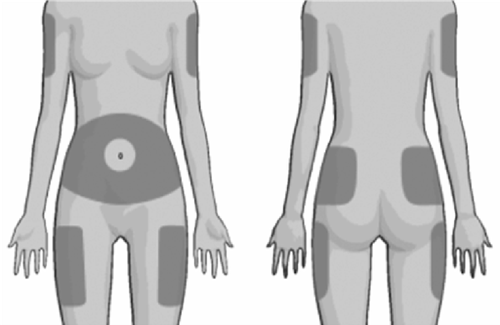
The recommended injection sites are:
- abdomen
- outer thighs
- top of buttocks
It is very important that the injection sites are varied and rotated regularly. This is to prevent areas of your skin from becoming thickened – this is called lipohypertrophy. You may have heard it referred to as ‘lipo’ or ‘lipos’.
These can develop in the fatty tissue where you give your insulin injections. If a ‘lipo’ develops, it can affect how your insulin is absorbed and will affect your glucose levels. If you notice you have a ‘lipo’, you should use a different injection site and rest the area for at least 6 months.
You may need to reduce your insulin dose and test your glucose levels more often if you move from an overused injection site. Changing your injection site will allow the insulin to be absorbed more effectively, which can cause lower glucose levels.
Lipohypertrophy can be prevented by ensuring good rotation techniques and making sure that needles are changed for every injection.
Your injection sites should be reviewed annually by your Diabetes Specialist Nurse (DSN). Also, it is a very good habit to inspect your injection sites yourself. Talk to your DSN about what to look out for when reviewing your sites.
The diagram below shows the acceptable injection sites.
Injection needle size
It is important to inject with the correct size of needle as this will also affect the absorption of the insulin. We recommend 4 to 5 mm needles no matter what a person’s weight is.
Needles are single-use only and should be changed for each injection. This will help to prevent lipohypertrophy. Needles should not be left on your pen device.
If you suffer from a needle phobia, please speak to your diabetes team to discuss aids and devices to help with this.
Hypoglycaemia (hypos)
Hypoglycaemia (known as a ‘hypo’) is when your glucose level is less than 4mmol/L. Hypoglycaemia can happen when you are treated with insulin for the following reasons:
- Physical activity
- Too much insulin
- Too little food, missed
- Alcohol meals, late meals
- Hot weather
Sometimes there is no obvious cause for hypos
What are the signs and symptoms of hypos?
A ‘hypo’ can be mild, moderate or severe, but must always be treated quickly. Hypoglycaemia warning signs and symptoms vary from person to person. Some people, especially if they often have low blood glucose levels, only have a few symptoms (known as loss of hypoglycaemia awareness). You may experience symptoms such as:
- Hunger
- Feeling
- Feeling anxious or shaky/dizzy/sweaty irritable
- Looking pale
- Tingling of lips and fingers
Other people may notice that you are:
- Uncoordinated /
- Not able to speak clumsy
- Having night sweats
- Irritable
Wear or carry a form of diabetes identification and make sure that other people know what to do if you have a hypo.
How to treat yourself if you have hypo:
- Stop what you are doing; you need to act immediately to treat a hypo.
- Take some fast-acting glucose:
- 5 to 6 dextrose tablets
- 4 to 5 glucotabs
- 3 to 4 jelly babies
- 170 to 220mls pure orange juice
- 150 to 190mls Coca Cola® (full sugar)
Due to the changing sugar content of Lucozade® and Ribena®, we no longer recommend using this as treatment.
3. Check your blood glucose level again after 10 minutes.
4. If your blood glucose level is still less than 4mmol/L, repeat Step 2. If your blood glucose level is more than 4mmol/L, move to Step 5.
5. Follow the fast-acting glucose with a snack:
- Half a sandwich
- Fruit
- Cereal
- Biscuits and milk
- Next meal (if due)
Hypos with loss of consciousness
Very low glucose levels can cause you to become unconscious. If this happens you must not be given anything by mouth and 999 (Emergency Services) must be called. If you have been prescribed Glucagon, this is when it should be used. You should be put on your side with your head tilted back (the recovery position).
After the hypo
- Try to think why you had a hypo, was there an obvious cause? If yes, can you make changes to prevent it happening again?
- After the hypo, your blood glucose level may be slightly higher for several hours due to the action you have taken to treat your low glucose.
- If you are experiencing multiple hypos, you should contact the diabetes team for advice.
Driving and hypos
- Keep glucose treatments in the car at all times.
- Before driving, check your blood glucose, it needs to be more than 5mmol/Land checked every 2 hours if you are on a long journey.
- If you have a hypo while driving, stop the car as soon as possible. Remove the keys to demonstrate you are not in charge of the car, move into the passenger seat, if safe, and treat the hypo as per the instruction at the beginning of this section.
- You need to wait at least 45 minutes after recovering from a hypo before you can drive.
Hyperglycaemia
Hyperglycaemia is a glucose level above the target range. It is impossible to avoid this all of the time, but if it happens regularly, it will affect your long-term diabetes control and therefore your overall health. In this situation, you need to adjust your insulin doses to reduce your glucose levels.
Causes of hyperglycaemia:
- Incorrect insulin dose for the amount of carbohydrates
- Reduced physical activity (for example if you have recently changed your job or you have retired)
- If you have recently been unwell or had an infection
- If you are feeling stressed
- Glycaemic index of food
- Change in your hormone levels
- Overused injection sites
If you find you are regularly experiencing hyperglycaemia, think about the following:
- Have you calculated your insulin dose correctly?
- When did you last eat or drink?
- Have you experienced a hypo recently?
- Are you feeling unwell?
- Have you started new medication such as steroids?
Correction doses
For occasional high glucose readings above your target range before meals, you could consider ‘correcting’ with rapid acting insulin in order to get your glucose ‘back on track’ into the target range.
There is a calculation to work out your individual insulin sensitivity factor (correction ratio):
Divide 100 by your Total Daily Dose of insulin (TDD). Your TDD is your total daily basal insulin in units + the average total amount of rapid insulin in units per day (i.e. breakfast units + lunch units + dinner units + any snacks).
For example:
Mr X gives 26 units Lantus each morning. He injects 6 units with breakfast, 8 with lunch and 10 with his evening meal. His TDD is 50 units.
100÷50 = 2.0
Therefore, 1 unit of insulin will reduce the blood glucose level by 2mmols/L. His correction factor is 1:2.
If you need to take correction doses on a regular basis, or there seems to be a pattern of hyperglycaemia, this suggests that your insulin levels need adjusting.
You can always discuss the changes needed with the Diabetes Specialist Nurse or Diabetes Specialist Dietitian.
Illness and ketones
It is important that you know what to do when you are ill. This can be referred to as your ‘Sick Day Rules’.
What are ketones?
Ketones are created when there is a severe lack of insulin, meaning that the body cannot use glucose for energy and starts to break down other body tissues for energy. Ketones are the by-product of this process. Ketones are poisonous chemicals and, if left unchecked and untreated can cause the body to become acidic.
Why is it important to test for ketones?
Ketones are acids which build up if you become unwell or have an infection. This may result in a condition called DKA (‘diabetic ketoacidosis’). Higher insulin doses and drinking plenty of fluids will be needed to bring down the level of ketones.
Vomiting may limit your intake of carbohydrate, so you must contact a health care professional if you are vomiting.
Checking for ketones when you are ill will alert you to what could be a dangerous situation.
Testing blood for ketones
You can test your blood for ketones by using a blood ketone meter. Your nurse will give you a meter if it is needed.
If you have type 1 diabetes it is important to test for ketones if your blood glucose levels are over 13.9mmol/L and not dropping over the following 2 hours or when you are ill (regardless of your blood glucose level).
When should you check for ketones?
You need to check your blood for ketones when you:
- are unwell
- have high blood glucose levels, above 13.9mmol/L
- are vomiting or have diarrhoea
Do not ignore the presence of ketones.
Please read the section on this page regarding sick day rules. This gives you important information about managing your diabetes during illness.
| What do the blood ketone results mean? | |
|---|---|
| < 0.6 mmol/L | Acceptable level |
| 0.6 – 1.5 mmol/L | Drink more fluids and take a higher insulin dose depending on your blood glucose level and/or have an insulin correction dose to reduce the blood glucose and ketone levels. It is important that the sick day rules are followed and that you re-check your blood ketone levels again in 1 to 2 hours. |
| > 1.5 mmol/L | This shows a risk of diabetes ketoacidosis. Continue the steps as above, take extra insulin and drink plenty of fluids. Seek medical help straightaway. *NOTE* the Diabetes Nurse contact number is not an emergency helpline – dial 999 |
Testing for Ketones in pregnancy
During pregnancy, ketones can develop at a lower blood glucose level than outside of pregnancy. If your blood glucose is more than 10mmol/L and you are not sure why it is high, please test for ketones.
If you are unwell, test for ketones even if your blood glucose is less than 10mmol/L. Once you have done this look at the table above and follow the appropriate steps. If you have ketones, you are likely to have high blood glucose levels, but sometimes they can be within the target range. This target will have been given to you by your antenatal diabetes team.
Sick day rules
What happens when you are ill?
People who have diabetes do not get more illnesses than other people. However, if you are ill, your blood glucose levels may be more difficult to control.
What happens to your diabetes when you are ill?
A rise in your blood glucose levels is part of the body’s natural response to illness. Blood glucose levels may rise, even if you are not eating and drinking. This is because your body releases sugars from its energy stores. Unless you keep up your intake of carbohydrate, your body will switch over to burning fat stores, which produces the acids called ketones.
What should you do if you are ill?
- Do not stop taking your insulin.
- You should stop taking metformin (if prescribed) if you have diarrhoea, vomiting or you are dehydrated. Metformin should be restarted when the diarrhoea and/or vomiting has resolved.
- Test your blood glucose levels more frequently than normal, even if you are not eating or drinking normally, as your blood glucose levels are likely to be high.
- Test for ketones, as instructed by your diabetes team.
- The presence of ketones suggests that you are lacking in insulin/carbohydrate and in danger of developing ketoacidosis.
- If you find ketones greater than 1.5mmol/L, you should seek urgent advice from your GP, practice nurse or the diabetes nurses at the hospital. The number is at the end of this page.
- Try to drink at least 2 to 3 litres (4 to 6 pints) of sugar free fluids, throughout the day, if your blood glucose levels are normal or high. If your blood glucose levels are low, drinks containing glucose are needed.
- Try to eat your normal diet or replace your meals with alternatives such as carbohydrate-containing drinks, for example milk, milk shakes, fruit juices or soup, ice cream, fruit, Complan®.
- If you are vomiting, you must contact your GP, diabetes nurses or NHS 111 for advice. You may require hospital treatment.
Insulin dose
Illness is one situation when you may need to adjust your insulin dose. This would be based on your blood glucose levels recorded just before you inject your insulin. During illness, you do not have to wait for 3 consecutive days of high blood glucose readings before making changes to your insulin doses.
If your blood glucose levels are:
- less than 13 mmol/L, continue with your normal insulin doses
- between 13 mmol/L and 20 mmol/L, increase your insulin doses by 2 units
- above 20 mmol/L, increase your insulin doses by 4 units
If you are not sure about how much to increase your insulin doses, please contact your GP, practice nurse or the diabetes nurses for advice.
If you have increased your insulin dose in response to illness, you will have to reduce the doses once you feel better to your original dose.
When to seek medical advice
You should contact your GP, the diabetes nurses or NHS 111 for advice, if:
- you are vomiting or have diarrhoea
- your blood glucose level is over 20 mmol/L
- your blood glucose level is under 4 mmol/L
- you have ketones on testing above 1.5mmol/L
- you are worried
Vomiting, diarrhoea, rapid breathing or drowsiness can lead to serious problems if not treated quickly. Hospital treatment is essential. Call your GP or NHS 111 for advice.
Annual review
You will be asked to come in for an annual review at the hospital and in some cases, also at your GP’s surgery, to have the following checked:
HbA1c
The recommended range is 48 to 53 mmol/L, but this may vary for some people.
Eyes
You will be called to have an annual eyesight check at the opticians and come to the hospital or your GP surgery for retinal screening. Please note, you must report any changes in your eyesight straight away.
Blood pressure
Have your blood pressure checked regularly; this is very important if you are taking blood pressure medication. The recommended target figure is 130/80 mmHg or lower
Cholesterol
Your total cholesterol level should be below 4.0 mmol/L.
LDL levels (bad cholesterol) should be less than 2.0 mmol/L.
HDL levels (good cholesterol) should be 1.0 mmol/L or above in men and 1.2 mmol/L or above in women. Triglyceride levels should be 1.7 mmol/L or less.
Immunisations
It is important that you have the annual flu vaccination and that you have had a pneumonia vaccination.
Foot check/care
You need to have a foot review at least once a year at the hospital or at your GP’s surgery. Please note, you must report any changes to your skin or sensation in your feet to your GP straight away.
Weight
It is recommended to maintain an ideal body weight for your height, known as Body Mass Index (BMI). BMI is a useful guide but is not the only tool to assess nutritional status. If you would like support in reducing your weight, please ask to see the diabetes dietitian.
Driving
Having diabetes does not stop you from driving, but your diabetes should be well managed. Your GP will have to complete a form for the Driver and Vehicle Licensing Agency (DVLA) to confirm that you are safe to drive with your diabetes.
If you have diabetes treated with insulin or certain oral medication, you must by law tell the DVLA and your insurance company.
Please be aware that there are restrictions in place for vehicles over 3.5 tonnes such as heavy goods vehicles and motor homes - it is important that you discuss these with the authority that grants these licenses. If you are driving a vehicle over 3.5 tonnes you will need to provide evidence of your blood glucose levels over a 6 week period.
Your license will be issued for 1, 2 or 3 years and renewal may require more medical information. Renewal is free of charge up until the age of 70 years old.
We would advise that you test your blood glucose before driving. If it is 5mmols/l or less, the DVLA say you must have a carbohydrate snack such as a cereal bar or sandwich before driving. On long journeys, you should stop and test your blood glucose every 2 hours.
Always make sure you have access to some form of quick acting glucose (such as a full sugar soft drink or dextrose tablets) and some form of slower acting carbohydrates (such as biscuits or a cereal bar). You could store these in your vehicle’s glove compartment.
If you feel hypoglycaemic while driving – do not ignore the warning symptoms
- As soon as possible and when it is safe to do so, pull over and stop the car.
- Remove the keys from the ignition, put them in the foot-well and move into the passenger seat.
- Treat the hypo as explained previously on this page.
- Do not drive until you are fully recovered (the symptoms have gone) and 45 minutes have passed.
You must inform the DVLA if you:
- have suffered more than one episode of severe hypoglycaemia (needing the assistance of another person) within the last 12 months.
- are a group 2 driver (bus or lorry) and you have suffered an episode of severe hypoglycaemia – this must be reported immediately.
- develop impaired awareness of hypoglycaemia.
- suffer severe hypoglycaemia while driving.
The DVLA address and website details can be found at the end of this page.
Travel
Having diabetes should not stop you from travelling. We recommend that you prepare by having the required vaccinations and arrange medical insurance.
Check that pre-existing conditions such as diabetes are not excluded. You can check the Diabetes UK website for further advice, please visit www.diabetes.org.uk Check that the strength of insulin that you use is available in the country that you are visiting (some countries use different strength insulin).
Always carry with you
- Extra supplies of insulin, pens, needles
- Blood glucose testing equipment
- Ketone testing equipment
- Fast acting glucose
- Medicines for minor illnesses
- Extra food and snacks in case of delays
- Identity card and/or identity jewellery
- A letter for customs stating that you are carrying sharps and medicines
- Copy of your prescription
All equipment to manage your diabetes needs to be carried in your hand luggage and not in the hold of the plane.
Insulin should be kept cool but not frozen. A cool bag/ FRIO® bag may be useful if you are visiting warm climates.
Please make sure you have enough carbohydrate for the journey. Hot and cold weather and changes in altitude can affect your blood glucose levels and as a result, your insulin doses may need to be altered. Test your blood glucose regularly and adjust insulin as required.
If you are taken ill while on holiday, seek medical advice early.
Never stop taking your insulin, even if you cannot eat solid food (refer to pages on illness).
Always wear footwear especially around swimming pools and on beaches to protect your feet from injury.
If you require advice about travelling through different time zones, please discuss this with the diabetes team.
Diabetes and pregnancy
Having children is a big decision for anyone, but for women with diabetes it is also a decision that requires careful thought and planning. It is recommended that you aim for a HbA1c less than 48mmol/mol before pregnancy to help reduce any risk of complications for both you and your unborn baby. Please let the Diabetes Team know that you are thinking about pregnancy before you stop using contraception.
Contraception
It is advised that you continue using a reliable form of contraception while improving your blood glucose management. By planning your pregnancy and being well prepared, you are reducing the risks of problems for yourself and your baby.
Blood glucose monitoring & HbA1C
We recommend aiming to get your HbA1c as close to 48mmols/mol before conception. This is to reduce the risks for you and for your baby. You can have your HbA1c measured monthly while planning for a pregnancy. This can be done at either the hospital or your GP’s surgery.
You should aim for your glucose levels to be:
- Between 5 and 7mmol/Lon first thing in the morning
- Between 4 and 7mmol/L before meals, and at other times of the day
If you are using a glucose sensor you should aim for a time in range of more than 70%.
Smoking
If you smoke, we advise you to stop. Smoking can seriously affect your baby’s health, particularly if you have diabetes, as well as having long term consequences for you. Your GP or midwife will be able to give you advice if you wish to stop smoking.
Folic Acid 5mg
If you have diabetes, it is recommended that 5mg of folic acid be taken 3 months before pregnancy and for the first trimester of your pregnancy. Folic acid 5mg is higher than the normal dose for pregnancy and is only available on prescription from your GP.
Medications
Do not stop or change any medication until you have spoken to your doctor. If you taking medication for high blood pressure and/or cholesterol this may be changed to a different type that is safer for you and your baby.
Insulin doses will increase as the pregnancy progresses, but women can usually return to their normal insulin levels after birth or when they have stopped breastfeeding.
Eyes
Eye screening for retinopathy should be carried out at least 6 months before pregnancy and will be carried out every 3 months during pregnancy. This is because any existing retinopathy can be worsened during pregnancy. If you have advanced retinopathy that has not been treated, we would recommend that it is treated before you become pregnant.
Diet
If you are overweight, it is recommended for both you and the baby if you can reduce lose weight to aim for a BMI to less than 27kg/m2 before becoming pregnant, if appropriate. Your dietitian will give you advice and support for managing your weight during pregnancy.
Alcohol
Drinking alcohol is not recommended during pregnancy due to the risks to the unborn baby. It also increases your risk of hypoglycaemia.
Contact the diabetes team when you are planning a pregnancy and when you discover you are pregnant.
Carbohydrate counting and bolus advisors
We hope by the end of the REACCT course you will be more confident in identifying foods and drinks which contain carbohydrates, and accurately calculating the grams of carbohydrates in them. At first, it will require extra time and motivation, but long term, there could be a number of benefits, such as:
The final step of carbohydrate counting involves adjusting your insulin to match the amount of carbohydrates you are eating. We will give you what is called an “insulin to carbohydrate ratio”, similar to your correction factor. This carbohydrate ratio will help you convert the amount of carbohydrates you are eating in grams, to insulin doses in units.
For example:
If your insulin to carbohydrate ratio was 1:10 and you were about to eat 60 grams of carbohydrates, you would inject 6 units (assuming glucose level is in target and no planned activity or stress)
Bolus advisor apps are a useful tool which simplify the ratios for you.
Bolus advisors are programmed with your insulin to carbohydrate ratio and your insulin sensitivity ratio (correction factor) to help give accurate insulin dose advice. For example, you enter your current glucose level and how many grams of carbohydrates you are about to eat, and it will tell you how much insulin to give.
Bolus advisors are only as good as the settings programmed into them. If your carbohydrate or correction ratio is wrong, the advice it gives you will be inaccurate. It is important you continue to monitor your glucose levels while using a bolus advisor.
Some bolus advisors have additional features, such as calculating “insulin on board” and allowing you to add “health events” such as illness or activity. These make the insulin dose recommendations more accurate.
Please contact the Diabetes Dietitians using the contact details at the end of this page for more advice.
Contact information
Diabetes Specialist Nurses
Gloucestershire Royal Hospital
Tel: 0300 422 8613 (Answerphone)
Cheltenham General Hospital
Tel: 0300 422 4266 (Answerphone)
Monday to Friday, 8:00am to 4:00pm. Please leave a message, your call be returned as soon as possible.
Email: ghn-tr.diabetesnurses@nhs.net
Diabetes Dietitians
Tel: 0300 422 8529 (Answerphone)
Please leave a message and your call be returned as soon as possible.
Email: ghn-tr.diet.diabetes@nhs.net
Diabetes Pregnancy Team
Further information
Diabetes UK
Website: www.diabetes.org.uk
My Type 1 Diabetes
Website: www.mytype1diabetes.nhs.uk