Self-administration of Subcutaneous Systemic AntiCancer Therapy (SACT)
A guide for patients self-administering. This page will help you to safely give yourself your treatment by subcutaneous injection. Subcutaneous means giving the injection into the fatty tissue layer just under the skin. Self-administration will allow you to have greater freedom and take control of your treatment.
On this page
-
Blood tests, appointments and other investigations
-
Equipment
-
Preparing to administer the injection
-
Administering the injection
-
Possible complications and side effects
-
Needle stick injury
-
Spillage
-
Spillage in the delivery bag or on the Syringe
-
If the medication spills onto your skin:
-
If the medication spills onto your furniture or floor
Your treatment is not licensed for self-administration, but we offer this service as it is safe for you to do so. It is the standard pathway for patients on these medications. If you would like to have your treatment given by a health professional discuss with the team.
Each stage of the process will be shown to you, and you will be given time to practice. A nurse will assess your safety and answer any questions that you may have. The nurse will complete a competency form with you. Then a referral form that will mean your medication and equipment will be delivered to your home address.
A nurse will show you:
- Preparation of your medication and the equipment involved
- How and where to give the injection
- Storing and disposal of the medication and equipment
- What to do if there is an unlikely occurrence such as a spill or accidental needle-stick injury
Blood tests, appointments and other investigations
You will receive a letter with the date of your next outpatient appointment. You may require blood tests and other investigations in between each medication delivery. You will be informed of this.
Equipment
The following items will be given to you by the nurse at the hospital for you to keep at home.
- Purple lidded sharps bin (this must be stored out of reach of children and pets).
- Spills Kit
All other equipment and any ongoing items will be delivered to your home, along with your medication.
Preparing to administer the injection
If you are feeling unwell, do not administer your injection. Call the 24-hour Acute Haematology Oncology Unit (AHOU) helpline on 0300 422 3444.
The syringe must not be handled by women who are trying for a baby, are pregnant or breastfeeding.
If your treatment is stored in the fridge, take out the syringe and wait for 30 minutes for it to reach room temperature.
- Clean a surface, such as a table or worktop, to work from.
- Place the equipment on the cleaned surface.
- Wash your hands with soap and water and dry thoroughly. If someone else is administering the injection, they must put on the gloves provided.
- Check the syringe has your name on it and it is in date. If any information is incorrect, do not give the injection. Please call AHOU.
- Check the syringe contents. It should look clear and without any particles in it. If it does not look clear, do not give the injection and call AHOU.
Administering the injection
1. Sit comfortably.
2. Identify where you will give the injection. You will have been taught the correct sites. Please refer to the end of this page for details.
3. You must rotate the injection site and inject at least 2.5cm away from where you previously injected if using the abdomen. Please use alternating thighs if this is where your medication is due to be given.
- Do not inject into skin that is red, hard, hot, swollen, bruised, broken, or damaged from a previous injection.
- Avoid scars, stretch marks and skin which is tender.
- Do not inject into a limb showing signs of swelling. - Do not inject if you are feeling unwell.
4. Clean a 10cm x 10cm area of skin vigorously with the alcohol wipe fully unfolded. Allow the site to air dry for 30 seconds.
5. Prepare the needle and syringe, as you have been taught by the nurse.
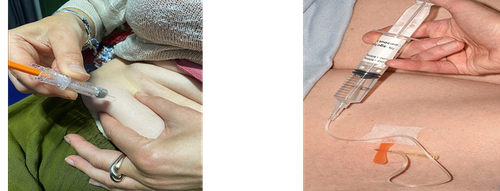
6. With your free hand pinch the skin at the site you are going to inject and insert the needle at a 45 to 90 degree angle.
7. When the needle is in place, slowly administer the medication over the specific amount of time you have been taught.
8. When the syringe is empty, activate the needle safety method you have been taught.
9. Dispose of all equipment in the sharps bin.
10. old the cotton wool or gauze over the injection site until any bleeding has stopped. Apply a small plaster, if needed.
11. Wash your hands well with soap and water, and dry thoroughly.
When the sharps bin is a third full, slide the hatch all the way across to seal it shut. You will hear an audible click. The sharps bins will be delivered and collected by the company.
Possible complications and side effects
While you are receiving treatment, your consultant will monitor that you are well enough to continue with the treatment and that your blood results and any other investigations are within safe limits.
If you experience any side effects, call the 24-hour Acute Haematology Oncology Unit (AHOU) Helpline on 0300 422 3444.
Please refer to your consent form for lists of side effects of your medication.
Minor redness may occur at the injection site. If this has not resolved within 24 to 36 hours, please call AHOU.
Needle stick injury
If you or the person administering your injection accidentally pricks themselves with the needle, you must do the following:
- Encourage free bleeding.
- Wash it with soap and water. Do not scrub.
- Cover it with a clean plaster.
- Contact AHOU.
Spillage
Leakage from your medication syringe is very rare, but if it does happen, the spillage requires immediate attention. You will have been given a ‘Spillage Kit’ which contains:
- 2 large absorbent sheets
- 2 plastic aprons
- 2 pair’s disposable gloves
- 1 orange bag
Spillage in the delivery bag or on the Syringe
- Open your ‘Spillage Kit’.
- Put on both pairs of gloves and the apron before touching the syringe.
- Lay the absorbent sheet on a flat surface.
- Take the syringe, being careful to hold it over the absorbent sheet.
- Wrap it in the absorbent sheet.
- Place it into the orange bag provided.
- Remove your gloves and apron and wash your hands.
- Contact the Acute Oncology and Haematology Unit on 0300 422 3444.
If the medication spills onto your skin:
- Open your ‘Spillage Kit’ and put on both pairs of gloves and apron.
- Wash your skin with plenty of cool, soapy water. Do not scrub your skin or use hot water.
- Take off any clothing that has been splashed and machine wash twice at 60 degrees or above.
- Re-wash if contaminated underclothes.
- Take off the gloves and apron and place them inside the orange bag provided.
- Close the plastic bag and dispose of it in the yellow cytotoxic bin provided. Make sure that the bin is tightly closed.
- Wash your hands with plenty of cool, soapy water.
If the medication spills onto your furniture or floor
- Put on both pairs of gloves and the apron from the ‘Spillage Kit’.
- With gloved hands, place the absorbent sheet over the affected area to soak up the spillage and to stop the spill from spreading.
- Clean the splashed furniture/floor at least 3 times with hot soapy water.
- Place all absorbent sheets, gloves and any materials used to clean up the spillage inside the orange bag provided.
- Close the orange bag. This orange bag must be placed into the yellow cytotoxic bin provided.
- To comply with waste regulations, orange bags or items exposed to medications must not be placed in a domestic waste/dustbin.
- Wash your hands with plenty of cool, soapy water.
- For further advice please contact the Acute Oncology and Haematology Unit 0300 422 3444.
The nurse training you to self-administer will provide the following:
- Their name
- The dose of your medication
- If you need regular blood tests
- Any other investigations
- The number of syringes/cycles to be supplied
- The colour of the medication/solution in the syringe
- Storage instructions for your medication
- Where your medication must be injected
- Any administration information (angle to inject and duration of injection)
- Any further information