Lung cancer
Lung cancer is the third most common type of cancer in the UK.
On this page
-
What to expect from your appointments with us
-
Preparing for your first appointment
-
Lung Cancer Nursing Team
-
Contact the team
-
What to expect from your diagnostic tests and investigations
-
Treatment options and what to expect
-
Preparing for your appointment with the cancer doctor
-
Useful links and information
The main risk factors for developing lung cancer are smoking and increasing age, however, between 10 and 20% of lung cancers occur in people who have never smoked.
What to expect from your appointments with us
If you have been referred from your GP then you will be seen in our urgent one-stop lung clinic by a respiratory doctor and lung cancer clinical nurse specialist (CNS). This clinic is held at the Community Diagnostic Centre, Quayside House in Gloucester Docks.
We call this a one stop clinic as depending on your needs, you may have a CT scan, breathing tests and/or blood tests during your visit. If so, we will try and get these done for you as quickly as possible but you may need to stay for up to 2-3 hours depending on how much needs to be done.
Although we may not be able to tell you exactly what the problem is on the day, we will be able to talk through what the CT scan has shown and whether any more tests are going to be needed.
Preparing for your first appointment
We welcome your questions and are keen to help make appointments as useful as they can be to you.
Considering the questions you want to ask beforehand can help ensure appointments cover the most important aspects to you. You can also discuss what to ask with your loved ones.
These examples are provided to help you decide what you'd like to know. There is no pressure to ask a certain number of questions; feel free to ask as many or as few as you need.
Questions you may find helpful to ask your clinician if cancer is suspected
Diagnosis
- Where is the suspected cancer at the moment?
- What has caused this potential cancer?
- Has it spread to other parts of my body?
- What kind of cancer is suspected?
- Is it treatable?
Tests and Investigations
- What further tests do I need?
- What will the tests involve?
- What can I expect during and after the tests?
- What will they tell us?
- When should the test be done?
Your questions
Any other questions you have, you may find it useful to write these down.
Lung Cancer Nursing Team
The lung cancer nurses offer a hospital-based service to patients who are suspected of having or have been diagnosed with lung cancer.
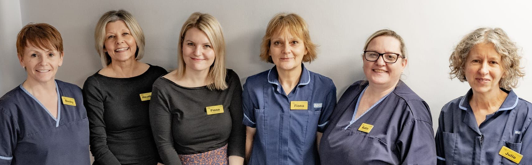
Nurses
Becky Preston, Heather Youd, Fiona Tomkins, Fiona Young, Katie Roberts, Julie Slight
We offer support and information for patients and those close to them about the investigations that may have to be undertaken. Most investigations can be done on an outpatient basis returning to clinic for the diagnosis. Some patients who know they have a suspected lung cancer prefer to have the diagnosis by telephone.
We continue to be contactable through investigations, diagnosis, through treatment to recovery or supported with symptom management and arranging input from community services.
We work closely with the respiratory, oncology and palliative care teams within the hospital and have close ties with the community services.
We are supported by an MDT coordinator and two specialist support workers. If you leave a message or send an email to us, please let us know your hospital MRN number, date of birth or National Health number, it helps us find your details on the system.
Contact the team
While under the care of our Lung Cancer team, please use this digital link to get in touch with us if you have any administrative or clinical questions for the nurses. Our telephone lines are very busy, so we recommend that you use the Accurx link for any non-urgent questions.
- Contact the team via Accurx: Accurx
Telephone numbers
- Gloucestershire Royal Hospital: 0300 422 5967
- Cheltenham General Hospital: 0300 422 2379
You can also see our contacts page for Cancer Clinical Nurse Specialists (CNS) and Cancer Support Workers (CSW)
What to expect from your diagnostic tests and investigations
Computerised tomography (CT) scans
CT scans take detailed internal pictures of your body and is usually the first step when assessing a lung abnormality that could be cancerous. Before having a CT scan, you’ll be given an injection containing a special dye, which helps improve the quality of the image.
Magnetic resonance imaging (MRI) scans
MRI scan uses strong magnetic fields and radio waves to create a cross sectional picture of the body. You might have an MRI in selected occasions
Positron emission tomography (PET) scans
PET scans produces a detailed three dimensional image inside of the body. Glucose is injected before the scan to reveal which areas of the body are ‘active’ and can help distinguish cancers from inactive areas like scar tissue. You might have a PET scan to assess whether a CT abnormality is worrying for cancer, or to see if a cancer has spread, or to plan the best target site for a biopsy.
CT guided biopsy
A CT guided biopsy is a minor invasive procedure performed under local anaesthetic. The CT scan is used to accurately guide a biopsy needle into an abnormality in order to get a sample of tissue that can be examined under a microscope. You can find out more about this procedure https://www.youtube.com/watch?v=h18zjzvwXkk
Bronchoscopy
This procedure involves an examination of the main breathing tubes in your lungs by passing a narrow fibre optic tube through the nose or mouth. It is performed under sedation and local anaesthesia to numb the throat. Although this is not done under a full general anaesthetic, it is usually well tolerated and most people are quite drowsy and may not remember too much about it afterwards. You can find out more about this procedure in the video below.
Endobronchial ultrasound (EBUS)
The test is a specialised type of bronchoscopy which includes an ultrasound probe on the end of the camera tube. The ultrasound probe allows us to find lymph glands with the chest and to take biopsies from these. You can read more about this procedure on the Macmillan Website Endobronchial ultrasound scan and biopsy (EBUS) | Macmillan Cancer Support or watch the video below.
Understanding your CT-Guided Biopsy
Understanding your Bronchoscopy
Understanding your EBUS Bronchoscopy
Treatment options and what to expect
Radiotherapy
This involves using radiation to destroy cancer cells. Radiotherapy may be given in high doses to people who are not fit for surgery or where a tumour is not operable, with the aim of trying to cure the cancer. This is called radical radiotherapy and this is sometimes combined with chemotherapy.
Radiotherapy can also be given in lower doses to try help control symptoms from cancer without curing it. This is called palliative radiotherapy.
Stereotactic Ablative Body Radiotherapy (SABR)
This is a way of giving radiotherapy to precisely target certain cancers, whilst avoiding as much surrounding healthy tissue as possible.
SACT treatments
You may hear the following treatment being described as SACT, which means systemic anti-cancer therapies. These include chemotherapy and immunotherapy and are treatments that work throughout the entire body.
Chemotherapy
Chemotherapy uses medicine to destroy cancer cells. When used to treat lung cancer, chemotherapy can be given straight into your vein through an intravenous drip or orally as a tablet. You may receive a combination of chemotherapy and radiotherapy.
Immunotherapy
Immunotherapy works by helping the immune system recognise and attack cancer cells. The type of immunotherapy given to lung cancer patients is known as checkpoint inhibitors, which work by blocking proteins that prevent the immune system from fighting the cancer cells. This treatment is given directly into your vein through an intravenous drip.
Targeted therapies
Targeted cancer drugs work by directly targeting the mutations that are causing cancer cells to divide and grow.
Surgery
Thoracic clinic
If surgery is advised you will attend the thoracic clinic. Thoracic surgery is performed in our nearest thoracic surgical centres in either Bristol or Birmingham, depending where you live. If you are referred for surgery then first the surgeon will see you in clinic to talk this through. This appointment could either be in Cheltenham, in Bristol or Birmingham, or online, depending on your needs and whether further in-person assessments of fitness for anaesthetic is needed.
This is not an option for all patients with lung cancer, as for some, the risks of the procedure may outweigh the benefits, and surgery is only helpful if the cancer has not spread widely. Before lung surgery you will have detailed assessments of your breathing to ensure that your lung function is sufficient to manage OK after a section of lung is removed.
There are three main types of lung surgery:
- Lobectomy: a lobectomy is a surgery to remove one of the lobes of the lungs. The lungs have sections called lobes. The right lung has 3 lobes. The left lung has 2 lobes. A lobectomy may be done when a problem is found in just part of a lung.
- Wedge resection or segmentectomy: a smaller section of the lung is removed. This is only used when the cancer is small and limited to one area of the lung.
- Pneumonectomy: where the entire lung is removed. This is used when the cancer is located in the middle of the lung or has spread within one lung.
Preparing for your appointment with the cancer doctor
Questions you may find helpful to ask your clinician following a cancer diagnosis
Prognosis
- How bad is this cancer? What does that mean for me?
- What symptoms will the cancer cause?
- What is the aim of treatment?
- How likely is it that the cancer will spread with/ without any more treatment?
- What's the best case scenario and worse case scenario?
- Where do you see me on that spectrum?
- Is the treatment likely to improve my survival? And/ or my symptoms?
Treatment Decisions
- What choice of treatment do I have?
- What are the pros and cons of treatment options? Or of no treatment?
- What will the side effects of treatment be?
- How long will side effects last?
- How would treatment affect my lifestyle and what matters to me?
- What is your opinion about the best treatment for me?
- When would the treatment start?
- What would the schedule be?
Getting ready for treatment
- Is there anything I can do before or after my treatment that might make it more effective (e.g. diet, exercise)?
- What are the do's and don'ts whilst having treatment?
- What problems should I look out for and who do I contact if they occur?
- What is my longer term follow up plan?
- Can I get a second opinion?
Clinical Trials
- What are clinical trials?
- Are there any that might be relevant to me?
- How might they help me?
Other information/ support
- Are there any other services or organisations that can help me and my family deal with my diagnosis?
Your questions
Any other questions you have, you may find it useful to write these down
Useful links and information
Investigations
Different types of Lung Cancer
Preparing for treatment
Surgery
- Types of surgery for lung cancer | Cancer Research UK
- Lung cancer | Thoracic Surgery University Hospitals Birmingham
- Thoracic Surgery (uhbristol.nhs.uk)
Oncology
- Chemotherapy for lung cancer | Cancer Research UK
- Targeted and immunotherapy treatment for lung cancer | Cancer Research UK
- Systemic anti-cancer therapies (SACT)
Radiotherapy
- Radiotherapy for lung cancer | Cancer Research UK
- Stereotactic Ablative Body Radiotherapy (SABR) For non-small cell lung cancer (gloshospitals.nhs.uk)
- Radiotherapy frequently asked questions (gloshospitals.nhs.uk)
Palliative care
- Specialist Palliative Care Services in Gloucestershire (gloshospitals.nhs.uk)
- Your guide to hospice and end of life care | Hospice UK
Patient information
- Macmillan Cancer Support | The UK's leading cancer care charity
- Home - Roy Castle Lung Cancer Foundation
- Mesothelioma UK | Supporting people with this asbestos cancer
- Help and Support for Those Affected By Mesothelioma and Asbestosis - HASAG
- Cancer Research UK
- Age UK | The UK's leading charity helping every older person who needs us
- Citizens Advice
Support groups and local charities
Our support page has details of local and national cancer support organisations.
Health and wellbeing
For more information to support you to keep well before, during, and after cancer treatment please visit our support and wellbeing pages.
Support our cancer services
Focus is the charitable fund for the Gloucestershire Oncology Centre, raising funds which directly provide extra care, specialist equipment and improvements to facilities for local cancer patients.