Anal sphincter exercises for men
The exercise information in this page has been written to help men who leak stool from their back passage or find it hard to control wind. Performing these exercises can help you to reduce leakage from the bowel by strengthening the sphincter muscles. If you are due to have a colostomy or ileostomy (stoma) reversal operation these exercises have been shown to help regain control more quickly. Practising these exercises daily can help you hold both wind and stool in the back passage.
Where are the sphincter muscles?
Your back passage or anus is made of 2 rings of muscle (see Figures 1 and 2).
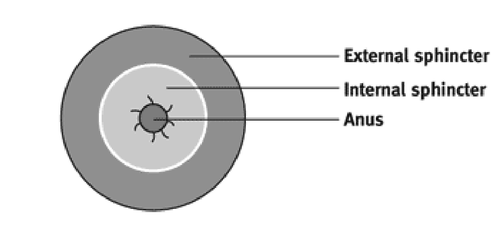
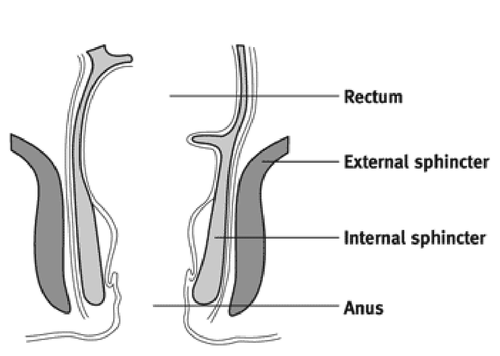
The internal sphincter is the inner ring of muscle which normally stays shut at all times; until you actually need to empty your bowels, when it should automatically open.
The external sphincter muscle is the outer ring of muscle which you can squeeze more tightly when you need to; for example when you have urgency or diarrhoea.
These muscles can get weak after regular episodes of constipation or straining, normal aging or because of lack of use such as while a stoma is in place. If you have weak muscles you may leak wind, liquid or solid stools.
If the muscles are damaged or weak, they may not close straight away or completely after you have been to the toilet. This often makes it difficult to wipe your bottom clean. You may also find that you leak during exercise, lifting heavy weights or when you walk a long distance. Some people also find that a small amount of stool is passed with wind.
How can exercises help?
The aim is to exercise these muscles enough to make them thicker and stronger so that they give more support and prevent leakage. Speeding up the reaction time of this muscle may also help with wind control.
Like any other muscle in the body, the more you use and exercise it, the stronger it will become. However, this will be hard work and often takes several months to be effective.
What are the risks?
No studies have reported harmful incidents or that people’s incontinence has worsened.
How do you exercise your sphincter muscles?
Sit comfortably with your knees apart. Imagine you are both trying to stop passing wind and stop the flow of urine while midstream. You should feel your scrotum (testicles) lift as you do this. Hold this for as many seconds as you can (up to a maximum of 10 seconds). At the end of the hold you should have a feeling of ‘letting go’.
It is easy to use the wrong muscles. Try not to strongly pull in your tummy, squeeze your legs together, clench your buttocks or hold your breath.
You can check that you are doing the exercises correctly by gently resting a couple of fingertips on the outside of the back passage. You should only feel a squeeze at your fingertips not in your buttock muscles. Please remember to wash your hands afterwards.
How often and how many?
To strengthen the muscles you need to do 24 exercises a day. To avoid over tiring the muscle, only 8 holds should be performed at a time with at least 5 seconds rest in between each hold.
So try doing 8 holds, 3 times per day.
Other tips
Use your muscles when you need them – pull up the muscles if you feel that you are about to leak stool or wind.
This can be more effective if you do a gentler squeeze that you can hold for longer, until the urge passes.
Try to manage your weight. Being overweight will put more strain on the muscles. See the NHS, weight loss plan by following the link at the end of this page or speak to your GP for advice.
Remember, you can practice these exercises wherever you are, nobody need know what you are doing!
For other advice about your problem please speak to your healthcare practitioner and see our leaflet GHPI1412 ‘Improving bowel function and control’.
How will I know if I am getting better?
It takes time to strengthen these muscles. Men often do not notice an improvement for at least 3 months. The best results happen by regularly exercising the muscles for 6 months.
Once your problem improves, it is a good idea to keep practising 15 squeezes every day for the rest of your life!
Contact information
If you have any problems or you do not understand any part of this page please contact your local continence physiotherapist:
Cheltenham General Hospital
Tel: 0300 422 2345
Monday to Friday, and leave a message on our voicemail.
Gloucestershire Royal Hospital
Tel: 0300 422 8303
Monday to Friday, and leave a message on our voicemail.
Gloucestershire Continence Service
Tel: 0300 422 5306
Monday to Friday, 9:00am to 5:00pm
Further information
NHS weight loss plan
Website: www.nhs.uk/live-well/healthy-weight/start-thenhs-weight-loss-plan/