Baby resuscitation
A step-by-step approach for parents and carers This page provides you, or those people who may be looking after your child, with a basic guide on what to do if your baby looks to be blue or is not breathing normally. Usually, young children have breathing problems before their heart stops beating normally. By helping them breath you are trying to prevent them getting more unwell.
If your baby looks blue and you think they are not breathing
Check the baby’s response:
- Gently pick up the baby and shout their name.
- If there is no response, shout for help and if someone is available, get them to ring 999 (or 112 from a mobile). If you are on your own, follow the steps below.
Open the airway:
- Place the baby on their back on a firm, flat surface.
- Look in their mouth and carefully remove any obvious obstructions such as vomit or food.
- Gently tilt the baby’s head so that the eyes are looking directly at the ceiling. Lift the chin up with one finger.
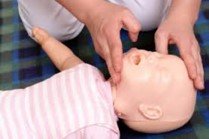
Check for breathing:
- Look – look at the baby’s chest for 10 seconds and see if the chest moves up and down.
- Listen and feel – place your cheek next to the baby’s face to check if you can feel or hear any breath from their mouth.
- If after opening the airway the baby starts to breathe, watch carefully until medical help arrives.
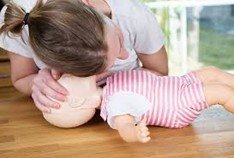
If the baby does not respond and is not breathing:
Call for an ambulance immediately, if this has not already been done.
Take the baby with you to the telephone. If you are able put the telephone onto loudspeaker. The ambulance service will be able to advise you until medical help arrives
Start rescue breathing:
- Keep the baby’s head in the ‘eyes to ceiling’ position with the chin lifted.
- Seal your mouth around the baby’s nose and mouth.
- Blow gently until the baby’s chest starts to rise.
- Move your face away from the baby, take a breath in and repeat.
- Do this 5 times.
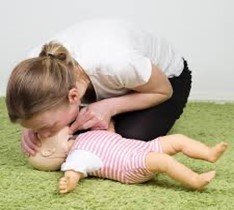
Check for a response from the baby:
- Look, listen and feel for signs of breathing, coughing or movement.
- Do this for no more than 10 seconds.
If no response:
Start chest compressions
- Place 2 fingers on the centre of the baby’s chest.
- Press down on the chest up to one third of its depth at a rate of 100 to 120 times per minute.
- After 30 compressions give another 2 rescue breaths and repeat (2 rescue breaths followed by 30 compressions).
- If the baby does not respond, continue with rescue breathing and chest compressions at a ratio of 30 compressions to 2 breaths, until medical help arrives.
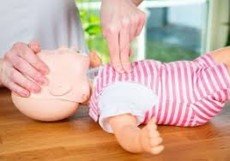
Summary of resuscitation
- Remember – Every Second Counts.
- Check response and shout for help. Dial 999 or 112 from a mobile.
- Clear and open the airway.
- If not breathing, give 5 rescue breaths.
- Check for signs of response.
- If no response, start chest compressions together with breaths (2 breaths to 30 compressions).
Continue until the baby is responsive (breathing) or medical help arrives.
Contact information
Neonatal Unit
Gloucestershire Royal Hospital, Great Western Road, Gloucester GL1 3NN
Tel: 0300 422 5529 or
Tel: 0300 422 5570