Considering gastrostomy insertion
This page explains what a gastrostomy tube is, why it may be recommended for your child, and what to expect before and after the procedure. It has been written to help parents and carers understand how gastrostomy feeding works, how to look after the tube, and where to get support if you need it.
Things to think about before deciding
A gastrostomy may be suggested if your child needs long-term support with feeding, fluids or medicines. It can help your child receive enough nutrition and may be more comfortable than a tube through the nose if tube feeding is needed for a long time.
Before making a decision, you may want to talk to your child’s doctor, dietitian or nurse specialist about:
- why a gastrostomy is being recommended for your child
- the possible benefits and risks
- any other feeding options
- what support you will have at home
- any questions or worries you have
You do not need to make a decision straight away unless your child’s clinical team tells you it is urgent. You can ask questions at any time.
What is gastrostomy tube feeding?
Some children are not able to take in enough food and drink by mouth. This may be for many different reasons and can sometimes be a long-term issue.
If a child is expected to need tube feeding for a long period of time, it may be recommended that they have a gastrostomy inserted. A gastrostomy tube is put straight through the skin directly into the stomach. It allows your child to receive feeds, fluids and medicines safely.
Types of Gastrostomy Tubes
There are two main types of gastrostomy tubes:
- Balloon-retained tubes
- Percutaneous Endoscopic Gastrostomy (PEG) tubes
Balloon retained tube
There are two types of balloon gastrostomy tubes:
- Balloon tube (BGT)
- Low-profile button (button tube)
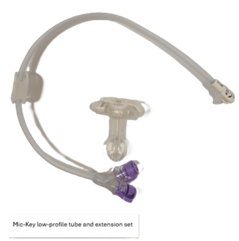
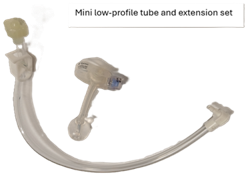
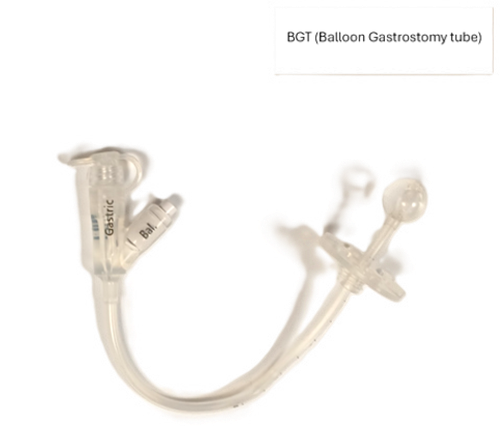
Balloon-retained tubes include low-profile “button” tubes and balloon gastrostomy tubes (BGT). These are held in place by a small balloon filled with water inside the stomach.
Button tubes need an extension set to give feeds or medicines. The balloon water must be checked every week. The extension sets can be washed and reused for one week. These will be provided through your feeding company deliveries. The paediatric enteral nutrition nurse specialists (PENNS) or children’s community nursing (CCN) team will show you what to do.
Button tubes should be rotated once a week, while BGTs should be gently advanced and rotated weekly, the CCNT will show you how to do this.
Balloon-retained tubes are usually changed every 12 weeks. PENNS nurses will arrange to visit for the first change. They will then hand this over to the CCN team. You can also be trained to do this at home if you feel comfortable.
PEG tubes
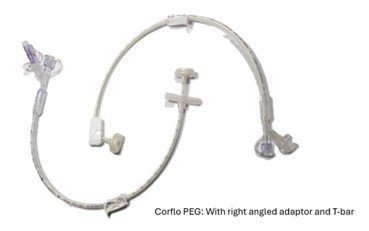
PEG tubes are different because they are held in place by a firm plastic disc inside the stomach. They are inserted by a surgical team and usually need to be advanced and rotated weekly to prevent complications such as buried bumper syndrome.
Buried bumper syndrome can happen when the disc inside the stomach becomes covered by stomach tissue. This can cause pain and swelling and needs urgent treatment. Moving and rotating the tube as advised helps stop the disc from becoming stuck in the stoma tract.
PEG tubes last longer than balloon retained tubes but must be changed every few years in hospital. This will be organised by the hospital where the tube was inserted and is often completed as a day case.
If a PEG tube becomes damaged or you are worried about its position, your child will need to be reviewed in hospital. Unfortunately, this cannot be replaced in the community.
Corflo PEG, right-angled adaptor and T-bar
Mic-key low-profile tube and extension set
Mini low-profile tube and extension set
Balloon gastrostomy tube
After the operation
Pain
After a PEG tube is put in, your child’s stomach and the area around the tube may be sore. Regular pain relief should help. If your child is still in pain, please contact the surgical team at the hospital where the tube was placed. Their contact number is at the end of this page.
Dressings
When your child comes back from surgery, they may have a dressing covering the tube. If it has, please follow the surgeon’s advice about when to remove it. The dressing is usually kept in place for 2 weeks until the stitches are removed.
Cleaning
Once this dressing has been removed, clean the skin around the gastrostomy opening, called the stoma, every day. Use sterile gauze and sterile water or cooled boiled water. Gauze will be given to you before your child goes home and can be prescribed by your GP.
After 4 weeks, you can use mild soapy water to clean the stoma site each day. Dry the area well afterwards.
Showers and shallow baths are allowed after two weeks, which will have allowed the stoma tract to heal. Avoid bubble baths or soaps on the stoma site.
Gastropexy sutures
Your child may have small button-like stitches on their stomach after surgery. These are called gastropexy sutures. They help hold the stomach close to the skin while it heals. PENNS will usually remove them 2 weeks after the tube is inserted.
They may come loose or fall off in that time. If 2 or more stitches fall off, or if they become painful or too tight, please get urgent medical advice from the surgical team at the hospital where the PEG was placed.
When to get urgent help
Please get urgent medical advice if:
- your child has severe pain, swelling or bleeding around the tube
- there is pain or swelling when you flush the tube
- the tube may have moved or come out
- the stoma is red, swollen, leaking, bleeding or has discharge
- your child has a high temperature or seems very unwell
- 2 or more gastropexy sutures fall off, or they become painful or tight
If you think the tube may have moved, do not use it for feeds, water or medicines until it has been checked.
Complications
Over granulation
Some children with gastrostomy tubes get overgranulation tissue. This is a small lump of tissue that can grow around the stoma. It is often harmless, but it can be uncomfortable and may bleed.
This can be treated with a steroid cream and dressings.
If you notice any over granulation, please contact PENNS or CCN team.
We advise using the recommended treatment for 2 weeks before considering a different treatment.
Infection
Check the stoma site regularly for signs of infection. These can include redness, swelling, discharge, pain or the area is feeling hot. If you notice any of these signs, please contact PENNS, CCN team, or your GP. They may need to check the stoma site and take a swab. We will wait for the swab results before starting antibiotics unless your child is unwell, in which case they should be seen by a doctor.
A swab is a small sample taken to check for infection.
If your child has a high temperature, is very tired, has a rash, or you are worried they may have an infection, please arrange for them to be seen. You can contact your GP or the paediatric assessment unit (PAU) at Gloucestershire Royal Hospital.
Leakage
Leakage can happen for different reasons. It is important to check what the leakage is and where it is coming from.
Leakage can come from:
- The stoma
- The stomach
- A damaged tube or a tube that has moved out of place
If you notice a leakage, pain or swelling when flushing the tube, stop using the tube. Do not use it again until it has been checked.
These may be signs that the tube is not in the right place. Please contact PENNS, the CCN team or PAU urgently.
What happens next?
If you decide that your child would benefit from a gastrostomy insertion, please inform their paediatrician or HEFT dietitian. A letter will be sent to the surgical team of the chosen hospital to ask for your child to be considered for gastrostomy insertion.
Patients from Gloucestershire are usually referred to Bristol Royal Hospital for Children. You can request to be referred to another hospital, but your child will only be able to be on the waiting list at one hospital at any one time.
Once the referral has been sent, the hospital will review it. If the referral is accepted, you will receive an appointment with the surgical team. This can take up to 6 months. After this appointment, if the surgeon thinks a gastrostomy is appropriate, your child will be assessed and placed on the waiting list for surgery.
The waiting list can be up to 12 months. The current total waiting time is usually 12 to 18 months from referral to gastrostomy placement.
If you decide later that your child no longer needs a gastrostomy, or their eating and drinking by mouth improves, you can ask for them to be removed from the waiting list. You can also ask to postpone surgery if needed.
If you have any additional queries or concerns, please do not hesitate to contact the Home Enteral Feeding Team and one of the PENNS team will be happy to discuss tube options and placement with you.
Community support at home
Before your child goes home, the hospital dietitians will review them. They will check that your child is managing enough feed. After discharge, you will continue to have contact with your child’s dietitian in the Home Enteral Feeding Team (HEFT).
The PENNS team will visit to check that you feel confident caring for the gastrostomy. They may remove any sutures, complete the first balloon water change, show you how to move and rotate the tube if needed, and complete the first tube change if this can be done in the community. Your feeding company deliveries will also change to include the supplies needed for a gastrostomy.
Swimming
Children with a gastrostomy tube are still able to go swimming and attend hydrotherapy sessions once their gastrostomy has been in for at least 12 weeks and is fully healed.
If the gastrostomy is infected, we would not recommend swimming until it is treated and healed. Some people prefer to cover their gastrostomy with a waterproof dressing, but this is not essential.
If there is no infection, but your child is having ongoing issues with their stoma site, it is advised to cover their gastrostomy with a waterproof dressing. Please discuss this with the PENNS or CCN team, as they can advise what type of dressing should be used and request these from your GP.
Oral hygiene
If your child is unable to take any oral fluids, they should receive regular mouth care. Keeping the mouth clean helps prevent infection. All children should be registered with a dentist and have regular dental check-ups.
If your child has little or no food by mouth, mouth care and dental care are still important. This can help prevent illness and keep your child comfortable.
If your child is supported by a Speech and Language Therapist, please follow any advice they give about oral care or safe swallowing.
Contact information
Home Enteral Feeding Team
Email: ghn-tr.homeenteralfeedingteam@nhs.net
Tel: 0300 422 5645
Monday to Friday, 08:30am to 16:30pm.
Please note we are not available on bank holidays.
When you call this number, please leave a voicemail message. Voicemails are checked regularly and help us assess calls effectively.
Children’s Community Nursing Team
Email: ChildrensCommunity@ghc.nhs.uk
Tel: 0300 421 8299
Monday to Sunday, 08:00am to 18:00pm.
For weekends and bank holidays use 07917 203432 Please note that the community teams may not be able to complete home visits at short notice. They may ask you to attend PAU at Gloucestershire Royal Hospital.
Your child will have open access to PAU at Gloucestershire Royal Hospital.
Bristol Royal Hospital for Children
Switchboard Tel: 0117 923 0000