Gastrostomy using a balloon retained tube: tube feeding at home
This leaflet explains how to look after your child’s balloon-retained gastrostomy, sometimes called a Gtube. It also explains how to give a feed, and some possible complications. A G-tube is a feeding tube that goes straight into the stomach through the skin. It is a safe, long-term way to deliver feeds, fluids, and medicines directly into the stomach.
There are two types of balloon gastrostomy tubes:
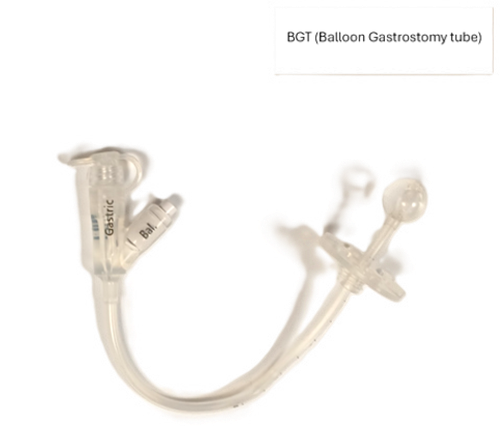
- Balloon gastrostomy tube (BGT)
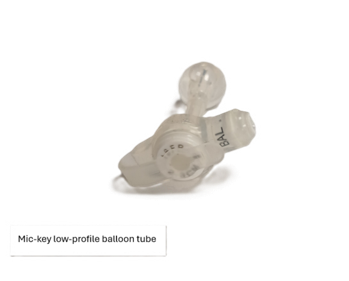
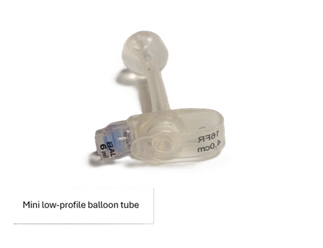
- Low-profile button (button tube)
Both types are held in place by a small balloon filled with water inside the stomach.
Balloon gastrostomy tube
Mic-key low profile balloon tube
Mini low-profile balloon tube
After the balloon or button tube is placed
Pain
After the tube is put in, your child’s stomach and the skin around the tube may be sore. Regular pain relief should help. If your child is still in pain, please contact the surgical team at the hospital where the tube was placed. Their contact number is at the end of this leaflet.
Dressings
When your child comes back from surgery, they may have a dressing covering the tube. If they do, please follow the surgeon’s advice about when to remove it. The dressing is usually kept in place for 2 weeks, until the stitches are removed.
Cleaning
Once this dressing has been removed, clean the skin around the gastrostomy opening, called the stoma, every day. Use sterile gauze and sterile water or cooled boiled water. Gauze will be given to you before your child goes home and can be prescribed by your GP.
After 4 weeks, you can use mild soapy water to clean the stoma site each day. Dry the area well afterwards. Showers and shallow baths allowed after two weeks, which will have allowed the stoma tract to heal. Avoid bubble baths or soaps on the stoma site.
Gastropexy sutures
Your child may have small button like stitches on their stomach following surgery. These are called gastropexy sutures. They are removed 2 weeks after the insertion by the paediatric enteral nutrition nurse specialists (PENNS) from the home enteral feeding team (HEFT).
They may come loose or fall off in that time. If 2 or more stitches fall off, or they become painful or feel too tight, please get urgent medical advice from the surgical team at the hospital where the PEG was placed.
How to care for your child’s balloon retained gastrostomy
Daily checks
Clean the stoma every day with clean water and gauze. Check the area every day for redness, swelling, discharge or signs of infection.
Weekly checks
Once the gastrostomy has been in for 4 weeks, the water in the balloon should be removed and replaced with fresh sterile water once a week. The first change will be completed by PENNS.
Once the gastrostomy has been in place for 4 weeks, a balloon gastrostomy tube should be moved forward and turned once a week. This is called advance and rotation. It helps prevent buried bumper syndrome, which is when the internal part of the tube presses into the stomach wall. The PENNS will complete the first advance and rotate, and the children’s community nursing (CNN) team will support with ongoing advance and rotation. To advance and rotate the tube, gently push it into the abdomen by 3 to 4 cm. Turn it all the way round once, then gently pull it back until you feel slight resistance. Do this once a week, unless you are told to do it more often. If your child has a low-profile button, the button will need to be rotated but not advanced. The extension set should be changed every 1 to 2 weeks. You will be shown how to do this by the PENNS or CCN team.
Tube changes - every 12 weeks
Balloon retained tubes need to be changed every 12 weeks. The PENNS team will arrange the first change. They will then hand this over to the CCN team. You can be trained to change the tube at home if you feel comfortable doing this.
Swimming
Children with a gastrostomy tube are still able to go swimming and attend hydrotherapy sessions once their gastrostomy has been in for at least 12 weeks and is fully healed.
If the gastrostomy is infected, we would not recommend swimming until it is treated and healed. Some people prefer to cover their gastrostomy for comfort, but this is not essential.
If there is no infection, but your child is having ongoing issues with their stoma site, it is advised to cover their gastrostomy with a waterproof dressing. Please discuss this with the PENNS or CCN team as they can advise what type of dressing should be used and it can be requested from your GP.
Oral hygiene
If your child is unable to take any oral fluids, they should have regular mouth care. Keeping the mouth clean helps prevent infection. All children should be registered with a dentist and have regular dental check-ups.
If your child has very little or no food by mouth, good mouth care is still important. It helps keep them comfortable and can help prevent illness.
If your child is supported by a Speech and Language Therapist, please follow any advice they give about oral care or safe swallowing.
Venting
Venting is the process of removing air from the stomach through the tube. This can help if your child has tummy discomfort. Venting can be done several times a day if needed. The PENNS or CCN team can show you how to do this safely. The steps are simple, as described below:
- If the tube has a clamp, close this initially,
- Remove the plunger fully from a 60ml syringe then attach to the end of the tube.
- If the clamp has been used, please open this
- Allow the air to escape by holding the syringe higher than the gastrostomy
- Wait for a few seconds to allow the wind to escape before re-clamping the tube.
- Once you start to notice feed or gastric contents coming up the tube, clamp the tube again, flush the tube with water and disconnect the syringe.
Complications
Over granulation
Some people with gastrostomy tubes get over granulation tissue. This is a small lump of tissue that can grow around the stoma. It is often harmless, but it can be uncomfortable and may bleed.
This can be treated with a steroid cream and dressings.
If you notice any over granulation, please contact the PENNS or CCNT for support. We advise using the recommended treatment for 2 weeks before considering a different treatment.
Infection
Check the stoma site regularly for signs of infection. These can include redness, swelling, discharge, pain or the area feeling hot. If you notice any of these signs, please contact the nursing team or your GP. They may need to check the stoma site and take a swab. We will wait for the swab results before starting antibiotics unless your child is unwell, in which case they should be seen by a doctor.
A swab is a small sample taken to check for infection.
If your child has a high temperature, is very tired, has a rash, or you are worried they may have an infection, please arrange for them to be seen. You can contact your GP or the paediatric assessment unit (PAU) at Gloucestershire Royal Hospital as soon as possible.
Leakage
Leakage can happen for different reasons. It is important to check what is leaking and where it is coming from.
Leakage can come from:
- The stoma
- The stomach
- A damaged tube or a tube that has moved out of place
If you notice leakage, pain or swelling when flushing the tube, stop using the tube. Do not use it again until it has been checked.
These may be signs that the tube is not in the right place. Please contact PENNS, CCNT team or PAU urgently.
Blockages
If you think the tube may be blocked:
- With a 60ml syringe flush the tube with warm water using a pulsing motion for at least 30 minutes.
- If that is not successful, with a 60ml syringe, flush the tube with unflavoured sparkling water using a pulsing motion for at least 30 minutes. If neither of these methods are successful, please contact HEFT, CCNT, or PAU.
Giving a feed
Wash your hands and prepare the feed if needed. Your child should not lie flat during the feed. They should be raised to at least a 30 degree angle during the feed and for at least 30 minutes afterwards.
This helps reduce the risk of vomiting or aspiration. Aspiration means feed or fluid going into the lungs. Follow the feeding plan given to you by your child’s dietitian.
Flush the tube with a small amount of water before connecting the feed. This helps check that the tube is not blocked and does not cause pain or leakage when used. Watch your child during the feed. If they vomit, stop the feed for a few minutes. Wait for your child to settle, then start the feed again. If the vomiting continues, or if you are worried, please contact the PENNS, CCNT, your child’s GP or PAU for advice.
After the feed has finished, flush the tube with the amount of water advised in your feeding plan.
Pump feed
Pump feeding may be needed to give the feed slowly and help your child manage it better. Please speak to your dietitian about whether pump feeding is suitable for your child.
For instructions on how to use a pump, please enter the following link into your browser and select Flocare Infinity III volume-rate therapy instructions for use.
Flocare Infinity pumps
https://www.nutricia.co.uk/hcp/resource-centre/flocareinfinity-pumps-instructions-for-use.html
Gravity bolus feed
If your feed plan says to gravity feed rather than pump feed, please follow these instructions:
- For a low-profile device, prime the extension set and then attach it to the end of the tube
- Connect the feeding tube to the syringe without the plunger and gently pour the required amount into the syringe. Do not overfill the syringe.
- If the feed is going down too quickly lower the syringe to slow it down. If the feed is going too slowly, raising the syringe will help to speed the rate up. Don’t feed too quickly.
- If the feed does not start straight away use the plunger to give a very light push to start the feed off.
Medications
Medicines should be in liquid form where possible. Give each medicine separately. Flush the tube with at least 5 to 10 ml of water before and after each medicine, unless you have been advised otherwise.
What to do if the tube comes out
If the tube has been in for less than 6 weeks:
Cover the stoma with gauze and take your child to the Emergency Department (ED) at the hospital where the tube was placed.
If the tube has been in for 6 to 12 weeks:
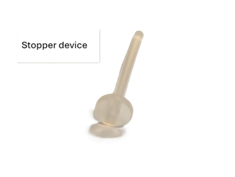
Use a stopper device if you have been trained to do this. Cover the area with a dressing or gauze and go to ED where the tube was placed. A stopper device helps stop the stoma, or hole, from closing.
If the tube has been in for more than 12 weeks:
Insert a stoma stopper device if you have been trained to do this. Contact the PENNS or CCN team as soon as possible.
It is important to keep the stoma open so the surgical team can put in a new tube. If the tube comes out less than 12 weeks after the gastrostomy was placed, there is a risk that a new tube could go into the wrong place and cause tissue damage. This is why your child needs to be seen by the hospital team, so the tube can be put back safely.
Stopper device
Support at home
Before your child goes home, the hospital dietitians will review them. They will make sure your child is managing enough feed. After discharge, you will continue to have contact with your child’s dietitian within HEFT.
The PENNS will arrange to visit you and your child. They will remove any stitches and complete the first balloon water change. You can learn to do this when you feel ready. The PENNS will also make sure you feel confident with the ongoing care of the gastrostomy. Your deliveries from the feed company will include the items needed for a balloon retained gastrostomy.
Contact information
Home Enteral Feeding Team (HEFT)
PENNS team sit within the HEFT.
Email: ghn-tr.homeenteralfeedingteam@nhs.net
Tel: 0300 422 5645
Monday to Friday, 08:30am to 16:30pm.
Please note we are not available on bank holidays. When you call this number, please leave a voicemail message. Messages are checked regularly. This helps us decide how urgent each call is.
Children’s Community Nursing Team (CNN)
Email: ChildrensCommunity@ghc.nhs.uk
Tel: 0300 4218299
Monday to Sunday, 08:00am to 18:00pm.
For weekends and bank holidays use 07917 203432. Please note that the community teams may not have capacity to complete home visits at short notice and may ask you to be seen in the PAU at Gloucester Royal Hospital.
Your child will have open access to the PAU at Gloucester Royal Hospital.
Bristol Royal Hospital for Children
Switchboard Tel: 0117 923 0000