Managing Type 2 Diabetes at home
This page covers some of the most important things that have been discussed with you during your admission. This page aims to help you through the first few weeks after diagnosis and will also give you advice and guidance to help you to make the safe transition from hospital to home. At first, the diagnosis of diabetes and learning the things you need to know about diabetes may seem overwhelming. Please talk to a member of the Diabetes Team; they have years of experience and during that time they have spoken to many families in similar situations. Do not be afraid to ask about something again if you do not understand it the first, second or third time. Remember there will always be ongoing support and guidance and our strongest recommendation is for you to contact the Paediatric Diabetes Team (see contact numbers) if there is anything you need help with, regardless of how small or silly you think it is.
On this page
-
General contact information
-
Emergency contact information
-
Open access
-
Coping with the diagnosis
-
What is type 2 diabetes?
-
What makes type 2 diabetes more likely?
-
Is type 2 diabetes serious?
-
How do I manage my diabetes?
-
Medication
-
Blood glucose testing
-
Blood glucose test results
-
Equipment to take home
-
Extra information if you are taking insulin
-
Injection technique guidance
-
Injection technique
-
Additional equipment you may take home if you are having insulin
-
Additional blood glucose testing if taking insulin
-
Low blood glucose levels
-
Treatment of low blood glucose
-
High blood glucose levels
-
Lifestyle and diet
-
Meat, fish, eggs, beans, pulses and nuts
-
Bread, potatoes and cereals
-
Fruit and vegetables
-
Milk, dairy and dairy alternatives
-
Fats
-
Food and drinks high in fats and/or sugar
-
Glycaemic Index
-
Physical activity
-
Follow up after discharge
-
Children’s Diabetes Clinics
-
What is glycated haemoglobin (HbA1c)?
-
Immunisations
-
Dental and optician
-
Back to school
-
What to do if you become unwell
-
Health checks and complications of type 2 diabetes
-
Complications of type 2 diabetes
-
Further information
-
Benefits advice
-
Medical alert bracelets
-
Useful websites
-
Useful apps
General contact information
Paediatric Diabetes Specialist Nurses
Tel: 0300 422 8473
Monday to Friday, 8:00am to 5:00pm
Email: ghn-tr.paediatricdiabetesnurses@nhs.net
Paediatric Diabetes Dietitians
Tel: 0300 422 5506
Monday to Friday, 8:30am to 4:30pm
Email: ghn-tr.paediatricdiabetes.dietitians@nhs.net
Psychologist
Tel: 0300 422 8117
Children’s Centre
Tel: 0300 422 8310 or 0300 422 8308.
Children’s Outpatients
Tel: 0300 422 8211
Emergency contact information
Diabetes Nurses
Tel: 07880 794616
This number is for emergency contact only and will be answered Monday to Friday, 8:00am to 5:00pm.
Out of these hours, please contact the Paediatric Assessment Unit.
Paediatric Assessment Unit
Tel: 0300 422 8309 or 07798695981
You will have been advised who your consultant, paediatric diabetes specialist nurse, and your paediatric diabetes dietitian.
Open access
The Children’s Centre (ward) operates an open access arrangement for all young people with type 2 diabetes. This means that if you have any serious concerns regarding your diabetes and wish to be reviewed, your parents can contact the ward and a doctor will give you advice on what to do. The contact details are later on in this page. You may be asked to attend the ward or you may be able to be managed at home.
Coping with the diagnosis
A diagnosis of diabetes may be a major shock to you and your family and it may take some time to come to terms with this. The period just after you find you have diabetes may be a very unsettling time. Family members may have a variety of feelings including shock, denial, anger, sadness, fear and guilt; which can put pressure on family relationships. It helps to keep in mind that each of us reacts in our own ways to stressful events. Although these feelings can be distressing, remind yourself they are a normal response to a challenging situation.
Your family are the best people to help you through this difficult time because you know them so well. The Diabetes Team’s psychologist is specially trained to help you understand your reactions and make sense of your family’s experience.
Asking for help is one way of coping. It also helps to be mindful of your own needs. This can mean putting aside some time just for you.
We recommend that you join Diabetes UK at www.diabetes.org.uk.
What is type 2 diabetes?
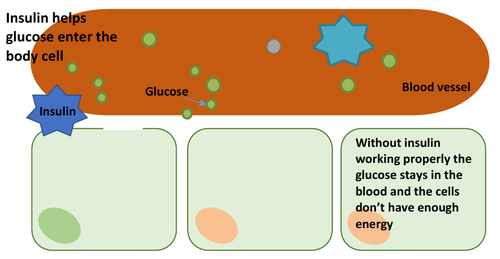
Type 2 diabetes is a condition when the insulin your pancreas makes cannot work properly, or your pancreas cannot make enough insulin.
We all need insulin to live. The food and drink we eat is broken down to glucose. This glucose enters the blood vessels and then our cells to give us energy, but it needs insulin to do this. In type 2 diabetes the insulin does not work very well so the glucose does not move into the cells effectively and the blood glucose levels (known as blood sugar levels) rise. The pancreas makes more insulin but it can eventually get tired and stop making as much insulin. This can make blood glucose levels higher again.
Because the cells in your body do not get enough energy you may have felt tired, needed to wee more, been more thirsty or had more infections.
What makes type 2 diabetes more likely?
We know that genetics can make type 2 diabetes more likely for example having parents or grandparents with type 2 diabetes. Because of genetics, certain ethnic groups are more likely to develop type 2 diabetes such as if you are South Asian.
We know that lifestyle factors can also increase the risk of developing type 2 diabetes. Being overweight is a main cause of type 2 diabetes. We also know that not exercising and being inactive can also increase this risk. This is why alongside medication, diet and exercise are really important.
Is type 2 diabetes serious?
You may know adults with type 2 diabetes. Type 2 diabetes in children and young people progresses at a faster rate than adult type 2 diabetes. This is why it is even more important for young people to have blood glucose levels in range as soon as diagnosed. Keeping blood glucose levels in range from diagnosis can reduce complications and also improve longer term blood glucose control.
High blood glucose levels for a long time can cause damage to parts of your body including your eyes, heart, feet and kidneys, known as the complications of diabetes. Having type 2 diabetes and high blood pressure can increase these complications. But with the right treatment and lifestyle, glucose levels and blood pressure can be managed and you can reduce the chance of developing complications.
Your Diabetes Team can talk to you more about this if you have any questions.
How do I manage my diabetes?
This is through diet and lifestyle and medication.
Studies show, if overweight, losing 5% of weight in 3 months from diagnosis and 10% in the first year can improve blood glucose control and overall health. We can talk more about this at your appointments.
There are also certain tests done when you are first diagnosed, including some blood tests and scans.
Medication
Before leaving hospital, you will have been advised as to how much medication you need.
Medication can help to lower blood glucose levels. There are different types of medications, including metformin and insulin. We may talk to you about other medications in the future.
Metformin
Metformin is a tablet that helps to stop the liver producing new glucose and improves how well insulin is used. It can also help with weight loss. Metformin does not cause low blood glucose levels if it is the only medication taken for diabetes.
Some people experience side effects, such as feeling sick or looser stools. If you experience any side effects, please discuss this with your Diabetes Team, who will be able to help. It is important that you do not stop your medication without speaking to your Diabetes Team.
The usual staring dose of metformin is 500mgs once a day with your evening meal; this can be increased if blood glucose levels are not reducing enough. We will talk you through when to increase metformin.
In very rare cases, metformin can cause more serious side effects that include severe tiredness, fast or shallow breathing, feeling dizzy. If this happens you must seek urgent medical advice.
Insulin
You may start insulin injections when diagnosed. This may continue or the injections may be reduced or stopped, depending on your blood glucose levels. You may have one or two types of insulin. We talk more about these later on in this page.
In the long term, you may produce less insulin and need insulin injections to help control your diabetes. Your Diabetes Team will discuss this with you and give you more information.
Other medications: (GLP1s and empagliflozin)
There are other glucose-lowering medications that have recently been approved for children and adolescents. These may be prescribed if needed. We will explain more about these medications during your appointments.
Blood glucose testing
Blood glucose levels should be tested often, especially in the early stages following the diagnosis of diabetes so we can help you to get the right amount of medication. If you are taking metformin, we ask for blood glucose testing:
- On waking
- 2 hours after lunch/midday meal
- 2 hours after tea/evening meal
Blood glucose test results
| When checking level |
Blood test result (mmol/L) |
Status | Intervention |
|---|---|---|---|
| Before meal | 4.0 – 6.9 | Normal | No action needed |
| Before meal |
More than 7.0 |
Above target |
Let your health care team know if levels are regularly above 7 before a meal |
| Two hours after meal |
Less than 8.5 |
Normal | No action needed |
| Two hours after meal |
More than 8.5 |
Above target |
Let your health care team know if levels are regularly above 8.5 after a meal |
If you have high blood glucose and symptoms of nausea, vomiting, deep or fast breathing, extreme thirst, are very fatigued or confused, please seek medical advice.
Equipment to take home
Metformin
This is the tablet which helps you manage your high blood glucose levels.
Nipro 4Sure Meter® and Diabetes:M®
Before you go home, we will show you how to use your Nipro 4Sure meter®, which you use to check your blood glucose with. We will also set you up with a phone app called Diabetes:M®.
This is used to record your blood glucose levels. You will be given 4Sure® blood glucose testing strips to take home to use in the blood glucose meter. We will also ask your GP add these to a repeat prescription for you.
Lancets
We will give you an Accu-Chek Fastclix® finger pricking device to take home. We will ask your GP to put the Fastclix® lancets on your repeat prescription.
Sharps bin
This is for safe disposal of all finger pricker lancets and used test strips. Only close the lid when the bin is full as you will not be able to open it again. Your GP will provide you with new sharps bins on prescription.
Some surgeries dispose of sharps bins or you can hand over sealed bins to your local pharmacy, you will need to check with your surgery for the local arrangement
Extra information if you are taking insulin
As mentioned earlier on this page, you may be told that you need one or two types of insulin. Both insulins are given by injection. Insulin helps to lower blood glucose levels.
Long-acting insulins are given once a day. They keep your blood glucose levels stable in the background. You may be prescribed Levemir®, Lantus®, Abasaglar® or Tresiba®. It is really important to give these injections at the same time each day.
Fast-acting insulins manage the sharp rises in blood glucose levels after a meal. They should be given immediately, or 15 minutes before each meal. You may be precribed NovoRapid®, Humalog®, Fiasp® or Apidra®. You may also be asked to give this insulin between meals if your blood glucose levels are high, this is called a correction dose as it brings the high blood glucose levels back into range.
Both insulins can cause a low blood glucose if too much is taken. We will talk about low blood glucose later in this book.
Injection technique guidance
It is recommended that both fast acting and long-acting insulins should be given in different sites. The usual injection sites are:
- Abdomen/tummy – we suggest this area is used for fast-acting insulin
- Front of thigh/lateral thigh – we suggest this area is used for fast-acting insulin
- Buttocks – we suggest this area is used for long-acting insulin
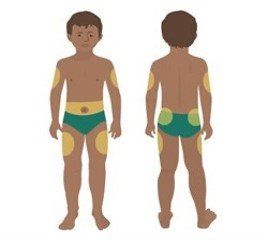
Avoid using injection sites that show a sign of lumps developing or is inflamed or infected. Lumps at the injection site, called lipohypertrophy, can cause problems with insulin absorption.
Injection technique
- Remove the insulin pen cap and check that you have the right insulin for the time of day.
- Screw on a new pen needle and remove both needle covers.
- Turn the insulin pen dial to 2 units and press down on the pen device button/plunger to release this insulin into the air so that you can check if the needle and pen are working correctly. When a drop of insulin has been seen the pen is ready to use.
- Then turn the insulin pen dial to the number of units you need to give.
- Choose the injection site. Inject into the chosen site at a 90° degree angle, pressing down on the pen device button/plunger as far as it will go. It will then automatically reset back to zero indicating the dose has been given.
- Count to 10 before taking the needle out of the skin.
- After giving the injection, take the outer needle cover (do not try to replace the small inner cover) and put this back on the needle, you should then discard this needle and cover safely into a sharps bin.
- Replace the insulin pen cap.
- If you have bruising or discomfort, please discuss this with your Diabetes Team.
Additional equipment you may take home if you are having insulin
4mm BD pen tip needles
The injection needles are for single use only and should always be discarded in a sharps bin after use. We will ask your GP to add these needles to your repeat prescription.
A 4mm pen tip needle is usually appropriate regardless of your age.
Long-acting insulin
This will usually be an insulin cartridge that goes into the injection pen. The insulin will be Levemir®, Lantus®, Abasaglar® or Tresiba®. These insulins all act in the same way.
The insulin cartridges not in use must be stored in the fridge. The insulin cartridge in use (i.e. in the insulin pen) does not need to be stored in the fridge but must be replaced with a fresh cartridge from the fridge every month.
Fast-acting insulin
This will usually be an insulin cartridge that goes into the injection pen. The insulin will be NovoRapid®, Humalog®, Fiasp® or Apidra®. These insulins all act in the same way.
The insulin cartridges not in use must be stored in the fridge. The insulin cartridge in use (i.e. in the insulin pen) does not need to be stored in the fridge but must be replaced with a fresh cartridge from the fridge every month.
Additional blood glucose testing if taking insulin
You may be asked to check blood glucose levels more often if taking both fast and long-acting insulin. This would be:
- On waking
- Immediately before all main meals
- 2 hours after main meals
- Before bed
We will let you know if you need to do this
Low blood glucose levels
Low blood glucose levels can happen if you are taking insulin. You need to treat a low blood glucose levels promptly. It is very important that you carry low treatment with you at all times (see below).
Warning signs
- Shakiness or dizziness
- Tiredness
- Sweating or feeling clammy
- Headache
- Feeling hungry
Or you might notice
- A pale complexion
- Dark tired looking eyes
- A change in behaviour such as a bad mood
- Disorientation
- Lack of concentration
Possible causes
- Planned or unplanned activity or exercise
- Hot weather or extremely cold weather
- Too much insulin at a meal time, e.g. if you didn’t eat the full meal
- Excitement
Treatment of low blood glucose
If blood glucose is below 4.0mmol/L:
Step 1.
Give a fast-acting carbohydrate for example:
- 3 to 4 x Lift™ Fast acting glucose tabs
- 1 x Lift™ Glucose shot
- 4 to 5 x Dextrose tablets
Please note that biscuits, chocolate, milk etc will not work fast enough and are not recommended. Some people use sweets or full sugar fizzy drinks or fruit juice. We would say to avoid these if possible as they are not as fast acting, but they can be used if nothing else is available.
Step 2.
Retest blood glucose level 10 to15 minutes later.
If the blood glucose is still below 4mmol/L, repeat Step 1 until blood glucose is above 4mmol/L.
If the blood glucose is above 4mmol/L continue as normal.
If the low blood glucose level was caused by a mis-calculation of carbohydrates with your previous meal or you know you are about to start some exercise, have a small long-acting carbohydrate snack such as 1 small apple or 1 digestive biscuit without insulin.
If your blood glucose is above 4 mmol/L and it is a meal time, give insulin as you normally would for that meal.
If you are finding that you are having to treat a low blood glucose more than once, or that after low treatment your blood glucose levels are often above 7 mmol, then contact the Diabetes Team as we may need to adjust your low treatment.
If you are having more than 3-4 low blood glucoses a week, please contact your Diabetes Team as we may need to adjust your medication amount.
High blood glucose levels
Blood glucose levels may drop and rise at times, but if your blood glucose level stays high for a long period of time this can lead to you feeling generally unwell, with increased thirst and tiredness. If this is happening, your medication may need to be increased, we advise you to contact the Diabetes Team.
Do not ignore high blood glucose levels as this could be dangerous.
Lifestyle and diet
Lifestyle and diet form an essential part of the treatment for your diabetes.
An active, healthy lifestyle can help:
- Lower blood glucose levels
- Lower blood pressure
- Improve cholesterol levels
- Lose weight or achieve a healthy weight
- Improve confidence and motivation
- Reduce the risk of diabetes complications
At each clinic appointment, you will see the diabetes dietitian and a healthy lifestyle can be discussed in more detail. We can also offer separate appointments.
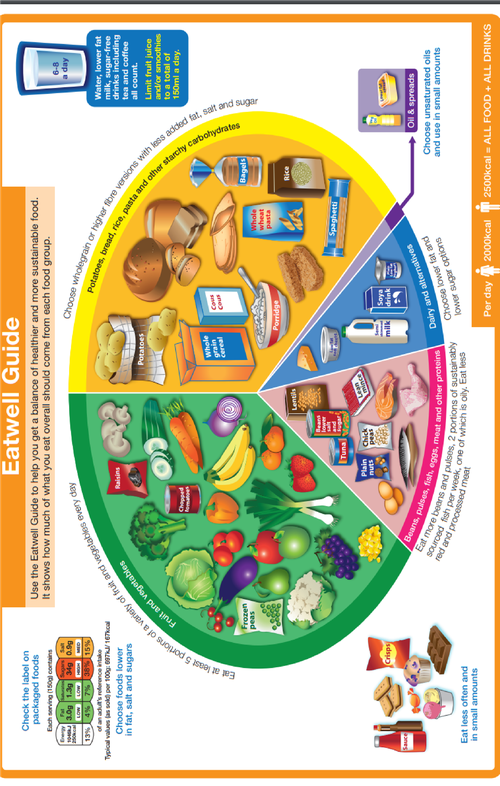
Understanding food groups can help you to know what types and amounts of different foods you should have.
The Eatwell Guide, on the next page, shows how much of what we eat should come from each food group to achieve a healthy, balanced diet.
You do not need to achieve this balance with every meal, but try to get the balance right over a day or even a week.
Meat, fish, eggs, beans, pulses and nuts
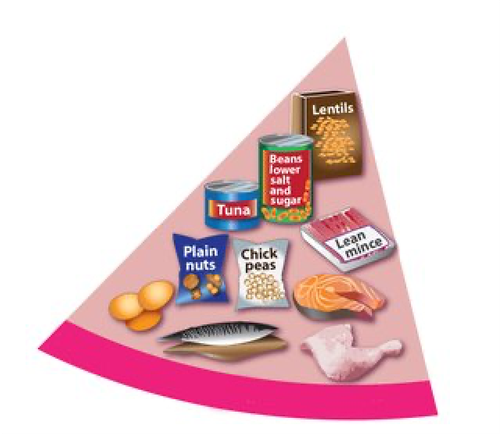
This food group is important for protein, which the body needs to grow and develop. These foods also contain nutrients like iron, zinc, magnesium and B vitamins. These foods should cover about a third of your plate.
Top tips:
- Choose lean meats (e.g. 5% fat mince) and remove visible fat
- Take the skin off chicken or turkey
- Cook these foods without adding fat e.g. by grilling instead of frying, baking or in a casserole
- Limit red and processed meat like bacon, ham and sausages
- Pulses, such as beans, peas and lentils, are good alternatives to meat because they are lower in fat and higher in fibre and protein
- Aim to eat 2 portions of fish per week, 1 of which should be oily fish such as, mackerel, salmon, trout, kippers, pilchards, sardine or fresh tuna
- Canned tuna is healthy but it does not count as oily fish as the oils are removed when it is canned
Vegetarian sources are:
- Soya-based foods (such as tofu and soya milk), beans, lentils and chickpeas, eggs, and milk. Seeds and nuts are also great but limit to 30g a day
Bread, potatoes and cereals
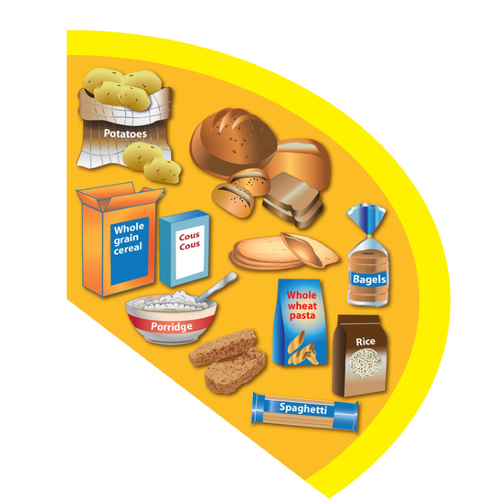
Starchy food should make up just over a third of the food we eat. Include them in every meal. They provide carbohydrates, calcium, iron, B vitamins and fibre.
Top tips:
- Choose higher fibre wholegrain varieties, such as wholewheat pasta and brown rice, granary bread
- Leave skins on potatoes
- Avoid adding fat o Opt for new, boiled or jacket potatoes over chips o If you have chips opt for oven chips over fried o If you have pasta, choose a tomato sauce rather than a cheese sauce
- Have reduced fat spread rather than butter on bread
- For breakfast try high fibre breakfast cereals or granary toast
Fruit and vegetables
Aim for at least 5 portions of fruit and vegetables each day. Fruit and vegetables are a good source of vitamins, minerals and fibre. They should make up a third of the food we eat each day.
Top tips:
- All fruits and vegetables (except for potatoes) count. This includes fresh, raw, cooked, canned, dried, frozen and juices as well as vegetables in soups, stews and sauces
- One portion is a handful of vegetables or a medium piece of fruit
- Fruit juice and smoothies should be limited to a small glass (150ml) once a day
- Aim for 3 portions of vegetables and 2 portions of fruit a day
- Fruit and vegetables are good because they are nearly always low in fat and high in fibre
- Beans and pulses count but only as 1 portion, however much you eat in a day
- Increase your intake of fruit and vegetables by adding them to dishes such as curries and stews or blend them into soups or smoothies
- Add vegetables to the top of pizzas and add fruit purees, stewed fruit or canned fruit to puddings
- Try to avoid adding fat or creamy sauces to vegetables, or adding sugar or syrup to fruit
Milk, dairy and dairy alternatives
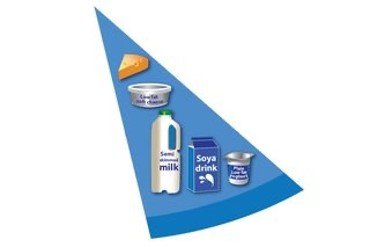
Foods in this group provide protein and calcium and are very important for our bones, teeth and muscles.
Once you stop growing it is not so easy to get calcium into your bones, so if you don’t get enough as a child/ teenager your bones may become weak as an adult. Not getting enough calcium can also make our teeth weak and may mean that our muscles cannot work properly.
Top tips:
- Try to have lower-fat and lower-sugar products where possible, such as 1% fat milk, reduced-fat cheese or plain low-fat yoghurt
- Aim for 4 portions a day from this group
- A portion is an individual standard yoghurt sized pot or a small glass of milk or a thumb sized piece of cheese
Fats
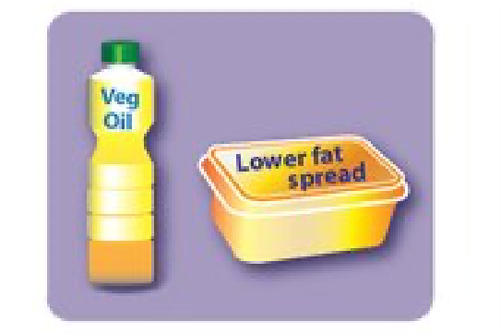
We all need some fats in our diet. Not all fats are as healthy as each other.
- Unsaturated fats are healthier fats and include vegetable, rapeseed, olive and sunflower oils
- All types of fat are high in energy and should be eaten sparingly
- Opt for light mayonnaise over full fat mayonnaise
- Bake or grill foods rather than using fats in cooking
- Use reduced fat spreads rather than butter
- Fats found in nuts, seeds and oily fish are good for you o Aim for one portion of oily fish a week o Limit nuts to a small handful/~30g maximum
Food and drinks high in fats and/or sugar

Most of us enjoy eating these foods. You do not need to give them up completely but you should only eat them in small amounts.
You should avoid all sugary drinks when you have diabetes as it can cause a quick rise in your blood sugar and affect your diabetes control.
This table gives you some alternative choices/healthier swaps.
| Ideas for healthier food swaps | |
|---|---|
| High sugar foods | Lower sugar foods |
|
Ordinary fizzy drinks, Coke®, lemonade, Lucozade® |
Diet, low calorie, slim-line or sugar free fizzy drinks, for example Diet Coke®, Pepsi Max®, Sprite Light® |
| Fresh fruit juice |
Have with a meal or dilute with water |
| Ordinary squashes | Sugar-free squashes |
|
Ordinary hot chocolate and malted milk drinks |
Reduced sugar hot chocolate drinks, for example, Highlights®, Options® |
| Sugar, glucose |
Artificial sweeteners in tablet or granulated form, for example, Canderel®, Sweetex®, Hermesetas® |
|
Sugar, chocolate or honey-coated breakfast cereals, for example, Coco-pops®, Frosties®, Ricicles®, Sugar Puffs®, Honey Nut Loops®, Frosted Shreddies® |
All other cereals, for example, Shredded Wheat®, Weetabix®, Shreddies®, Cornflakes®, Branflakes®, Fruit and Fibre®, Ready Brek®, Porridge |
|
Ordinary jams, marmalades and honey, treacle and syrup |
Ordinary jams, marmalades and honey, treacle and syrup, pure fruit spreads (used in small amounts) |
|
Ordinary tinned or instant puddings made with sugar, for example, milk puddings, instant custard, whips and jellies Ordinary yogurts and fromage frais |
Sugar-free tinned or instant puddings made with artificial sweetener, sugar-free instant custard, sugar-free whips, and sugar free jellies Home-made milk puddings made with a sweetener Diet yogurts and fromage frais |
| Fruit stewed with sugar Fruit tinned in syrup |
Fruit stewed without sugar (add an artificial sweetener to taste if required) Fruit tinned in natural juices. Fresh fruit |
| Rich fruit or iced cakes |
Home-made reduced sugar sponge cake, malt loaf, tea cakes, hot cross buns, crumpet, plain, fruit or cheese scones |
|
Sweet, cream-filled or chocolate biscuits |
Plain biscuits e.g. digestives, rich tea, ginger snaps Cereal bars, for example Harvest® or Quaker® |
Glycaemic Index
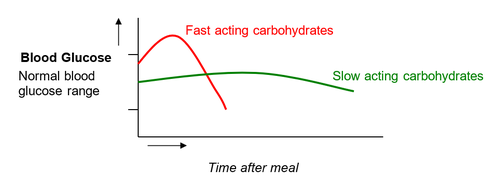
Some carbohydrates are fast acting; they are quickly digested and make your blood glucose level rise quickly.
These are called high glycaemic index carbohydrates.
Some carbohydrates act more slowly, they are slowly digested and make your blood glucose level rise gradually.
These are called low glycaemic index carbohydrates.
If you have diabetes, it is best to include slow acting carbohydrates to prevent large fluctuations in blood glucose levels. Those in italics below are particularly slow acting.
| Low glycaemic index carbohydrates | High glycaemic index carbohydrates |
|---|---|
|
Breakfast cereals: Weetabix®, Porridge, Shreddies® |
Sugary drinks (including fruit juice) |
| Breads: wholegrain, granary | Sweets |
|
Pasta and noodles |
Table sugar |
|
Rice: basmati |
Glucose tablets |
| Beans | Lucozade®/energy drinks |
| Milk | |
| Fruit |
If you want to have a small amount of fast acting carbohydrates as a treat, make sure you have them with slow acting carbohydrates (for example after a meal) as this will make your blood glucose rise less quickly.
Physical activity
Being active is beneficial for all children and young people. We encourage the whole family to get active together as this is more likely to be fun, sustained and effective.
Being active can:
- Promote weight loss
- Keep the heart healthy
- Lower blood glucose
- Lower blood pressure
- Improve well-being
- Is an important part of your diabetes management
Reducing the length of time spent watching TV, playing on the computer and video games can help. Try to limit screen time to less than 2 hours per day.
Children and young people should do at least an hour (60 mins) of moderate to vigorous physical activity a day. You will know if you are doing this as it will increase your heart rate and makes breathing harder and you might get a bit sweaty. Examples include brisk walking, active play, dance, sports and active games.
This does not have to be done all in one go, by breaking it down into 10 minute chunks your goal is easier to reach.
Here are some ideas to get you started:
- Throw a frisbee or kick a ball around at the park
- Walk or run round the block
- Climb a tree or a hill
- Walk the dog (ask your neighbours if you don’t have one)
- Start a paper round
- Go dancing or use a dance mat
- Play twister with your mates
- Go window shopping
- Ride your bike
- Skip 200 times (with or without a rope)
- Hang out the washing
- Water the garden or help with weeding
- Wash the car
- Walk on short journeys rather than getting a lift in the car
- Get off the bus a stop early and walk the rest
- Encourage your family to do something active together at the weekend
- Walk up escalators or take the stairs and avoid the lift
- Get moving by helping out with household chores
- Do something active during TV ad breaks, such as climbing your stairs
If you regularly take part in exercise or sports, please ask the diabetes dietitian for more information to help you manage your diabetes.
Follow up after discharge
After you are discharged from hospital, the Paediatric Diabetes Team will keep in regular contact.
Children’s Diabetes Clinics
You will receive 3 monthly appointments with your consultant, dietitian and nurse. Any young person under paediatric care will be offered at least 4 clinic appointments per year.
If you are unable to attend a clinic appointment, please try and give at least 24 hours’ notice beforehand. Where possible, we will try to fit you into the next available clinic slot. If that is not possible, we can arrange a personal appointment outside of the normal clinic hours to make sure that you do not go too long before being seen by a member of the team.
Repeated non-attendance at clinic is viewed as a serious concern.
At every clinic (every 3 months):
- The outpatient staff will measure your height and weight to check for growth
- A HbA1c finger prick sample will also be completed (see ‘What is glycated haemoglobin (HbA1c)
- Your blood pressure will be measured
At your annual review clinic appointment (once per year):
- You will have an annual blood screen to check your cholesterol levels. This involves you being given a form to get a blood sample taken at the hospital or at your GP’s surgery
- If you are over 12 years old you will be asked to get a retinopathy screen (photographs of the back of the eye) to check for healthy blood vessels in the eye.
- If you are over 12 years old you will be asked to give a urine sample so that your kidney function can be checked.
- If you are over 12 years old you will have a foot check in clinic to check for healthy feet
- We will complete a psychological screening assessment to ask how you are feeling
- We will ask about smoking, the flu vaccine and talk about how to manage illness
- We will also go through the education check list for type 2 diabetes, so that we can support you with any gaps in education if needed
- We will talk about sleep/sleep disturbances to rule out obstructive sleep apnoea
What is glycated haemoglobin (HbA1c)?
HbA1c stands for glycated haemoglobin and is an average measurement of how much blood glucose is ‘sticking’ to the red cells in the blood.
A finger prick blood sample will be taken at every clinic to measure the HbA1c. This is important as it tells us how stable your blood glucose levels have been over the last 3 months, on average the higher the HbA1c, the higher the blood glucose levels.
You will naturally have a high HbA1c on your first clinic visit because your blood glucose levels would have been very high for some time before you were diagnosed with type 2 diabetes. The first HbA1c result received at clinic is not something to be concerned about, but we hope to see it reducing over future visits.
An HbA1c of 48mmol/mol or lower is the target for good health.
Immunisations
The Department of Health recommends that all children (over the age of 6 months) and young people with type 2 diabetes have annual immunisations against influenza. It also recommends immunisation against pneumococcal infection for children and young people with diabetes who need insulin or oral hypoglycaemic medicine.
Dental and optician
All children and young people are advised to have regular dental and eye examinations.
Back to school
Deciding when you return to school should be between you and the school. Before you return, we may offer the school a visit from the paediatric diabetes specialist nurses to educate school staff about your diabetes and provide them with a health care plan. You will be invited to attend this meeting.
What to do if you become unwell
If you become unwell, (for example, with a cold, flu or an infection) your blood glucose levels may become high even if you are not eating. The signs of high blood glucose (hyperglycaemia) include being thirsty, passing more urine than normal, tiredness and high blood glucose meter readings.
You should monitor your blood glucose levels more often and contact the Diabetes Team for further advice.
If you take medication for your diabetes, it is important to keep taking it as the infection may cause your blood glucose to rise - even if you are not eating.
If you are ill and unable to eat your usual meals, you should try to eat or drink something containing carbohydrate to give you some energy. It is important to stay well hydrated so drink plenty of sugar-free fluids. If you start vomiting or are unable to keep fluids down you must seek medical advice straight away.
Hyperosmolar Hyperglycaemic State (HHS)
Hyperosmolar Hyperglycaemic State (HHS) occurs in people with type 2 diabetes who have very high blood glucose levels. It can develop over a course of weeks through a combination of illness and dehydration. Blood glucose levels can rise due to the effect of the other hormones the body produces in illness. Symptoms can include frequent urination, great thirst, nausea, dry skin, disorientation and in later stages - drowsiness and a gradual loss of consciousness. Hospital treatment for HHS aims to correct dehydration and bring the blood glucose levels down.
You must seek medical help if you are experiencing any of these symptoms.
Health checks and complications of type 2 diabetes
The thought of getting diabetes complications can be very worrying. Having a high HbA1c or persistently high blood glucose levels, will put you at greater risk of diabetes health related problems or “Complications of diabetes”. Taking action now will benefit your health in the future.
Complications of type 2 diabetes
High glucose levels can damage blood vessels, nerves and organs. This can lead to:
- Heart disease and stroke
- Nerve damage
- Diabetic retinopathy
- Kidney disease
- Foot problems
Smoking can increase your risk of diabetes complications
Further information
Patient Advice and Liaison Service (PALS)
Contact the PALS team if you have any concerns about your care.
Tel: 0800 019 3282 (Freephone)
Benefits advice
You may be eligible for Disability Living Allowance (DLA), especially if you have insulin prescribed as you will need more regular blood glucose checks and are at risk of hypoglycaemia. To request a claim form, please contact the Department of Work and Pensions. These benefits are to help you with the extra costs associated with your diabetes.
Department of Work and Pensions
Tel: 0800 121 4600
Medical alert bracelets
Wearing a medical alert bracelet is advised for young people with diabetes so that in the event of an emergency, people can be alerted to the condition and help. This is especially important if you take insulin due to the risk of hypoglycaemia (lows). If you do not want to wear medical ID, you can get medical ID on your mobile phone. Medical alert bracelets are available to order online through many websites, as listed below:
Website: www.medicalert.org/medical-id/medical-ids-bracelets/
Website: https://theidbandco.com/for-medical/
Website: www.mediband.com
Website: www.medi-tag.co.uk
Useful websites
NHS
Diabetes UK
BDA
GOV.UK
Useful apps
Carbs and Cals
My Fitness Pal