We use cookies to provide you with a better service. Carry on browsing if you’re happy with this or read more about our cookie policy and privacy policy.
Dr John Smallwood, Dr Charlotte Dobson, Dr Oliva Murphy
We're proud to announce the release of our annual review, Proud to Care, covering the period from April 2024 to March 2025
This page gives you information about how to care for your wound following a caesarean section operation to deliver your baby.
Cryotherapy is a treatment for benign and precancerous skin lesions. Liquid nitrogen (-196°C) is sprayed from a canister onto your lesion(s) for a few seconds. This will sting briefly.
You have been advised to have a flexible sigmoidoscopy to help investigate the cause of your symptoms. It is important that you read this page before you have the procedure so that you understand what will happen and the preparation involved.
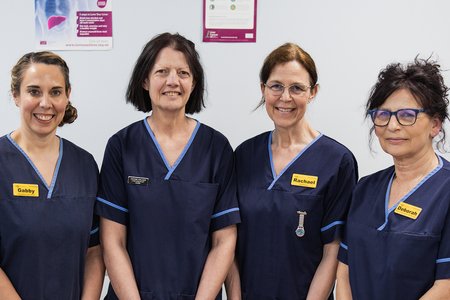
The Liver Specialist Team plays a vital role in the NHS, delivering comprehensive care to patients with liver diseases, and providing medical and emotional support throughout the treatment process. Since Debbie Durrant was appointed as the Trust’s first Liver Specialist Nurse in 2009, demand for the service has increased and we now have four specialist nurses at Gloucestershire Hospitals who manage a caseload of around 900 patients.
Thanks to your support, a new research role has been funded to help support patients recovering from weight loss surgery.
Our Resuscitation (Resus) Department are holding a CPR-a-thon on 16 October in aid of Cheltenham and Gloucester Hospitals Charity.
This page gives you information about the care following the removal of your feeding tube. Your feeding tube has now been removed by traction and the stoma site (the hole the tube has come out of) should heal up quickly, usually within 24 hours. Some feeding tubes require endoscopic removal; this would be done under sedation.
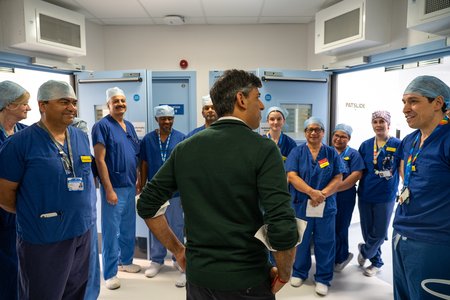
The Prime Minister, Rishi Sunak, and Cheltenham MP, Alex Chalk, paid a special visit to Cheltenham General Hospital yesterday (Thursday 14 March) to see our new £17.2m dedicated surgical unit and two theatres.
Our Chief Executive has been named one of the top 50 CEOs in the NHS in The Health Service Journal.
This page gives you information about what to expect following your glossectomy.
Urethral bulking is designed to treat stress urinary incontinence and has been approved by the National Institute for Health and Care Excellence (NICE). This page gives you information about the procedure, the risks and possible complications.
This page is a general guide for you, your family and friends.
A better career starts here at Gloucestershire Hospitals NHS Foundation Trust. Make a difference and become a healthcare scientist! During Healthcare Science Week we are inviting year 11s and above to meet our teams, take a tour and take part in interactive sessions.
This page gives you information about faecal microbiota transplantation (FMT), including the benefits, risks and what to expect.
This page gives you information about care following your gastroscopy and Bravo™ capsule placement.
Flexor tendons are the elastic cord like structures which arise from the muscles in the forearm, running into the hand and attached to the bones of the fingers.
The wrist is the most complex joint in the body and the term ‘arthritis‘ is used to describe a swelling in a joint.
This is a surgical removal of the Dupuytren's in which a skin graft is taken from your arm or hip