We use cookies to provide you with a better service. Carry on browsing if you’re happy with this or read more about our cookie policy and privacy policy.
The aim of this booklet is to provide you or those caring for you with the necessary information to feel confident in caring for your laryngectomy. There is a lot of information which we have tried to simplify by grouping into sections.
This page gives you information about having a laparoscopic removal of fallopian tube(s) and ovary(ies):
This page provides information for patients having coronary angioplasty at Gloucestershire Royal Hospital. This procedure is also known as PCI (Percutaneous Coronary Intervention).
The doctors looking after you/your family member are considering performing a tracheostomy. This is to help with your overall treatment while you are a patient in the Department of Critical Care (DCC). We have written this page to give you information about having a tracheostomy. It explains what a tracheostomy is, what the procedure involves and the possible risks. We hope that it will help to answer some of the questions you may have. If you have any further questions or concerns, please speak to a member of the Critical Care team.
This page gives you information about how to manage or support bladder and bowel care needs of a person with dementia. Dementia is a term used to describe a range of increasing neurological disorders (conditions affecting the brain). This could be a problem or difficulty with the person’s memory, thinking, concentration and other functions of the brain which may affect their daily functions such as toileting.
This page is a guide to Endovascular Aneurysm Repair surgery and should help to answer some of the questions you may have.
The information on this page is for patients having a bladder tumour removed by a Trans Urethral Resection of Bladder Tumour (TURBT) operation.
This page gives you information about having cardiac catheterisation, also called cardiac angiography (angiogram).
Between 10th - 12th September 2019, Gloucestershire Hospitals held their Inaugural Festival of Quality Improvement, Research & Innovation at Gloucestershire Royal Hospital and Cheltenham General Hospital.
This page gives you information about Wide Local Excision (WLE) of a vulval lesion. This is a treatment for pre-cancerous, recurrent and early cancer of the vulva.
This page gives you information about Interval Debulking Surgery (IDS) for ovarian cancer and answers some of the commonly asked questions.
Where to get advice and information We understand that this page has been referred to you at a very distressing time. The loss of a child is a life changing event and understandably you will experience a wide range of emotions. We hope that you will find useful information on this page that meets your individual needs.
The aim of this booklet is to provide you or those caring for you with the necessary information to feel confident in caring for your tracheostomy. There is a lot of information which we have tried to simplify by grouping into sections.
This page gives you information about transperineal biopsy of the prostate, including the nature of the procedure, risks, benefits, alternatives and what to expect.
This page gives you information about uterine prolapse and laparoscopic hysteropexy (also known as sacrohysteropexy). This procedure is performed for women who wish to have uterine preservation surgery for their prolapse.
Experience of care week is an opportunity to show the breadth of the patient experience team, the services we offer to support our patients and their carers and how we respond to their feedback.
This page has been written so that you will have the names and contact details for the Gynaecological Cancer Care team. We have also included some other resources that you might find useful.
This page gives you information about having a Computed Tomography (CT) guided lung/pleural biopsy. It explains how the procedure is carried out and some of the possible complications.
This page gives you information about vaginal vault prolapse and its repair, known as sacrocolpopexy.
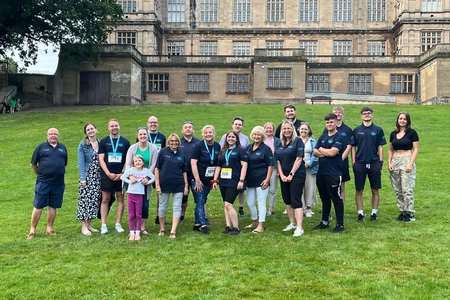
We are incredibly proud of all our competitors and their supporters attending our first entry to the British Transplant Games. Some of the team share their stories below.