We use cookies to provide you with a better service. Carry on browsing if you’re happy with this or read more about our cookie policy and privacy policy.
Changes to Cheltenham A&E during BMA Industrial Action 17 - 22 December
This page provides information for women and birthing people who have been identified as being at risk of having a preterm (premature) birth. We hope that this information will help you to understand the risk factors and how the Preterm Birth team will support you during pregnancy to try to reduce the risk.
This page has been designed to help you exercise your sphincter muscles. Sphincter exercises can help you to reduce leakage from the bowel. These exercises are also beneficial for patients who are due to have a colostomy or ileostomy (stoma) reversal operation. When done correctly these exercises can build up and strengthen the muscles to help you to hold both wind and stool in the back passage.
This page gives you information about intermittent claudication, the causes and treatments that may help to reduce the risk.
Doctors divide nerve injuries into three simple groups and understanding the difference between these groups can help predict whether or not surgery to the nerve is required
When Ian Henderson asked his dentist to look at two painless marks in his mouth, little did he know it would lead to the words no one wants to hear, ‘you have cancer’.
If it’s suitable for your care, you can now attend hospital appointments remotely with online video calling.
This page provides Fever advice for children and young people
This page provides information for patients who may need to have an indwelling pleural catheter.
This page provides you with basic information about vaginal vault prolapse and how it is repaired with a procedure called pelvic floor repair and sacrospinous fixation. Sacrospinous fixation is a vaginal procedure performed for women who have developed vaginal vault prolapse after a hysterectomy.
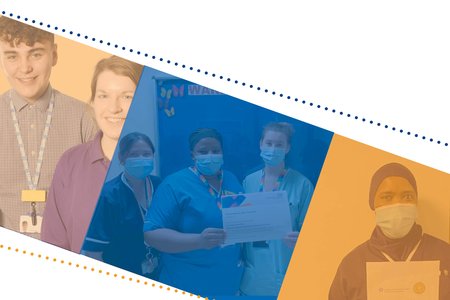
In National Apprenticeship Week, congratulations to Emilie Burden and Hayley McNeil from our Acute Medicine Same Day Emergency Care (SDEC) team who recently completed their 3-year Level 7 Apprenticeship in Advanced Clinical Practice
by Rebecca Draper
The aim of the study is to see whether regular endoscopic surveillance is better than endoscopy at need for detecting early signs of oesophageal cancer in patients diagnosed with Barrett’s oesophagus.
This page gives you information about aftercare following your CT scan of the heart.
by Dr Paul Perkins
This industrial action by Resident Doctors, led by the British Medical Association (BMA), will take place from Wednesday 17 December (7am) until Monday 22 December (7am)
We would like to extend our deepest sympathy to you at this time. The early days following bereavement can often be bewildering and difficult. This page has been prepared to offer information for bereaved parents who have suffered the loss of a baby after 24 weeks of pregnancy. We hope you find the following information helpful.
The Endoscopy Unit at Gloucestershire Royal Hospital is celebrating the opening of its upgraded facilities, following the installation of state-of-the-art imaging technology, that will significantly enhance patient care.
Giving in memory of a loved one lets you celebrate their life whilst also making a lasting difference to the lives of future patients
To install critical infrastructure for the Emergency Department (ED) extension, we’re bringing in a large crane from 12 September that will be lifted over the front of the Atrium. Alternative access for drop-offs is available.
This page provides information for people travelling by car and bus to Cheltenham General and Gloucestershire Royal Hospitals. We know that travelling to an appointment can be stressful, so please leave extra time before your appointment. This will allow time for parking. You will need to bring change with you should you need it. Hospital maps are available on our website and these highlight the locations of the car parks.