We use cookies to provide you with a better service. Carry on browsing if you’re happy with this or read more about our cookie policy and privacy policy.
Our five year strategy
In 2024, we commissioned two independent reviews to identify what more we could learn from seven maternal deaths (2017–2023) and 44 neonatal deaths (2020–2023)
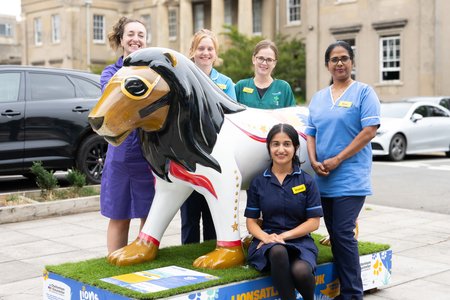
Our pride of lions that has captivated the community will be going under the hammer to raise funds for a new state-of-the-art cancer centre in Cheltenham
Our Focus Support and Information Centre is situated in the heart of the Oncology Centre in the outpatient waiting area of Cheltenham General Hospital.
The Care Quality Commission (CQC) has downgraded the Trust’s overall rating from 'Good' to 'Requires Improvement' following a recent inspection.
You have been asked to come to the hospital for an oral Glucose Tolerance Test (GTT). This page gives you information about the test and the preparations needed.
This page provides you with information about the Neonatal Unit. We understand that Neonatal Units (NNU) can be very different to other wards, so we want to make sure that you are partners in your baby’s care and help you to develop a close and loving relationship while also making you feel welcome on the unit.
This page gives you information about the options available to remove your PEG. Also included is care advice for you to follow after the procedure.
Temporary changes to services at Gloucestershire Royal and Cheltenham General Hospitals will help ensure better and safer care for patients as we move into the next phase of the pandemic, clinicians have said.
This page gives you information on care following banding of piles (haemorrhoids).
Find out how our pain management service can help you live well with pain.
These drugs are described as Systemic Anti-Cancer Therapies (SACT).
Ganglion cysts are the most common type of swelling in the wrist. They are completely harmless and usually disappear within a few years.
This page has been written so that you will have the names and contact details for the Gynaecological Cancer Care team. We have also included some other resources that you might find useful.
Latest on staffing challenges and the impact on maternity services at Stroud Maternity and Cheltenham Aveta
This page gives you advice and information about Prostap® or Zoladex® treatment for non-cancerous gynaecological conditions such as fibroids, endometriosis and severe Premenstrual Syndrome (PMS) or Premenstrual Dysphoric Disorder (PMDD). Please see below for explanations of these conditions.
This page has been designed to help you exercise your sphincter muscles. Sphincter exercises can help you to reduce leakage from the bowel. These exercises are also beneficial for patients who are due to have a colostomy or ileostomy (stoma) reversal operation. When done correctly these exercises can build up and strengthen the muscles to help you to hold both wind and stool in the back passage.
Antimicrobial resistance (AMR) represents a major global threat across human, animal, plant, food, and environmental sectors.
Your oncologist has recommended that you have a course of radiotherapy to help manage your condition. This page aims to tell you about radiotherapy and what will happen. Please be aware that radiotherapy centres are training centres for doctors, nurses and radiographers, including both male and female members of staff. Students may be present in the department but they are supervised at all times. If you would prefer not to have students present during your treatment please let a member of staff know. You may find it useful to write down some questions before you start your treatment.