We use cookies to provide you with a better service. Carry on browsing if you’re happy with this or read more about our cookie policy and privacy policy.
This page will give you information about having hernia surgery. It also answers some of the commonly asked questions and outlines some of the risks and possible complications linked with hernia surgery.
The artwork, entitled Untitled 2021: A Moment to Pause, was created after it was identified that patients needed a more soothing environment when arriving in A&E, particularly as a result of a mental health crisis, in a space that was cared for and invested in.
You have been referred this page because your kidneys are no longer functioning efficiently. Excess water and waste need to be removed from your body in another way, through dialysis. The method of dialysis you have chosen is peritoneal dialysis. To enable you to have this type of dialysis, you will need a Peritoneal Dialysis (PD) catheter.
by Tracey Cullerne
The central slip is the name given to the tendon responsible for pulling the middle knuckle joint straight. Usually, the proximal interphalangeal joint or second knuckle joint becomes swollen and tender, and the finger will not pull straight easily.
You have been advised to have a gastroscopy and colonoscopy (also known as an endoscopy) to help investigate the cause of your symptoms. It is important that you read this information before your appointment so that you understand what will happen during these procedures and the preparation needed.
The doctors looking after you/your family member are considering performing a tracheostomy. This is to help with your overall treatment while you are a patient in the Department of Critical Care (DCC). We have written this page to give you information about having a tracheostomy. It explains what a tracheostomy is, what the procedure involves and the possible risks. We hope that it will help to answer some of the questions you may have. If you have any further questions or concerns, please speak to a member of the Critical Care team.
This page provides information for renal patients with a fistula or graft who need a fistulogram or fistuloplasty. The page answers some of the commonly asked questions about having a fistulogram or fistuloplasty. It also explains the benefits, risks and alternatives to the procedure.
This page gives patients with arthritis advice on how to manage a flare (worsening of symptoms).
This page provides information about parental responsibility. A person with parental responsibility is vital in making decisions about a child’s medical treatment. We can only share health information about a child with carers who have parental responsibility.
You have been advised to have a therapeutic gastroscopy which provides treatment carried out via an endoscope. A gastroscopy may also be referred to as an endoscopy or OGD (meaning an oesophageal-gastroduodenoscopy).
We're working in partnership with Gloucestershire Libraries to promote free digital library services, including thousands of eBooks, eAudiobooks, eMagazines and eNewspapers that can be enjoyed via your smart phone, tablet, or laptop.
This page gives you information about the care you will need following a thoracoscopy.
The ‘End PJ paralysis’ campaign aims to help patients to become active in their recovery, keep their independence and help improve mental wellbeing and dignity.
You have been advised to have a trans-nasal endoscopy to help us to investigate the cause of your symptoms. This page contains information about having a transnasal endoscopy through the nose. It is important that you read this page before your appointment so that you understand about the procedure and the preparation involved.
This page explains what a molar pregnancy is, how it is diagnosed and how it is treated. It also answers the frequently asked questions.
For polycythaemia;
by Andy Champion
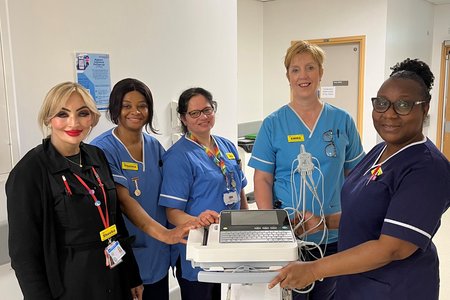
Thanks to your support, a state-of-the-art ECG (electrocardiogram) machine is helping patients at our Trauma and Orthopaedics Department.