We use cookies to provide you with a better service. Carry on browsing if you’re happy with this or read more about our cookie policy and privacy policy.
Changes to Cheltenham A&E during BMA Industrial Action 17 - 22 December
Gloucestershire Managed Services have announced the appointment of a new Chair, Kaye Law-Fox.
The early pregnancy assessment clinic is an emergency service if you are between 7 and 15 weeks pregnant and experience pain or bleeding.
Six year old Thomas was the first patient at Gloucestershire Royal Hospital to be part of Harvey’s Gang when he visited our pathology labs with his brother Lewis and mum Lorraine on 20th December.
Vaginal cancer is a very rare cancer that's found anywhere in the vagina. It's most common in women aged 75 and over.
This page explains what a hysterectomy involves and answer some of the more commonly asked questions.
Miss Hillaby has a specialist interest in gynaecological oncology. She performs a range of procedures including:
In order to discharge its duties effectively, the Board is required to have a number of statutory Committees.
Chemical Pathology
Every June, Dietitians Week celebrates the vital work of registered dietitians across the UK — the only qualified health professionals who assess, diagnose and treat dietary and nutritional problems at both individual and wider population levels.
This page gives you information about Photodynamic Therapy (PDT) for the age-related eye conditions macular degeneration and Central Serous Chorioretinopathy (CSCR). The aim of this page is to explain what to expect at all stages of the treatment and to answer some of the commonly asked questions.
Abatacept is a fusion protein that consists of the extracellular domain of human cytotoxic T-lymphocyte-associated antigen 4 (CTL1-4) linked to a modified Fc portion of human immunoglobulin G1 (IgG1).
The 13th GSQIA Graduation and Awards Ceremony took place on Friday, 28th of June 2019 from 9:30am – 12.30pm in the Lecture Hall at Redwood Education Centre, Gloucestershire Royal Hospital.
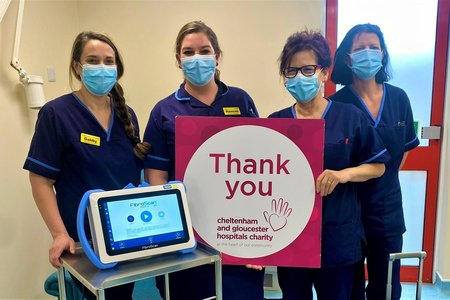
A Fibro Scanner is a type of ultrasound that is used to assess liver fibrosis in a non-invasive way. The equipment can help to provide a prompt diagnosis, which is especially important as 90% of liver disease is reversible if detected early. This also enables the hepatology team to organise a treatment plan as soon as possible for patients. The Fibroscan procedure is quick and painless, and can also help in emergency situations by providing accurate readings of liver damage in less than 15 minutes.
On 2 September, Sharon Cornwell of our Site Management team marks a major milestone with 50 years of service in the NHS.
This page gives you information about Osgoods Schlatters Syndrome (OSS) and how it is best managed.
by Kate Mennie, Julie Harvey and Cathryn Braithwaite
Information for parents Your child has been started on a medicine called methotrexate (meth-oh-trex-ate). This page gives you information about the medicine, the precautions you need to take and the possible side effects.
This page has been written to help answer some of the questions you may have about your peripherally inserted central catheter (PICC). It also explains why you need a PICC line, what to do before you come in for the procedure and how to care for it when you are at home. If you have any other questions or concerns, please do not hesitate to speak to the nurse or doctor caring for you.
Hereditary haemochromatosis (HH) is a very common inherited disorder of iron metabolism, characterised by inappropriately high absorption of iron, leading to excessive storage in the liver, skin, pancreas, heart, joints and testes.
Who to contact and how to get advice from the departments in our pathology service.