We use cookies to provide you with a better service. Carry on browsing if you’re happy with this or read more about our cookie policy and privacy policy.
Changes to Cheltenham A&E during BMA Industrial Action 17 - 22 December
You have been advised to have a trans-nasal endoscopy to help us to investigate the cause of your symptoms. This page contains information about having a trans-nasal endoscopy through the nose.
Thanks to our incredible supporters across Gloucestershire, an amazing £600,000 has been raised for a new scanner that will help thousands of patients in the county.
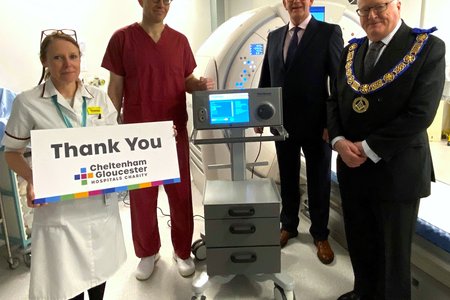
Thanks to a generous donation by the Provincial Grand Lodge of Gloucestershire Freemasons, a new jet ventilator has been funded for Gloucestershire Hospitals
Antimicrobial resistance (AMR) is one of the most significant global health challenges of our time, which is why we are supporting this awareness week this November
You have been advised to have a gastroscopy and colonoscopy (also known as an endoscopy) to help investigate the cause of your symptoms. It is important that you read this information before your appointment so that you understand what will happen during these procedures and the preparation needed.
This page gives you information about the reversal of Hartmann’s procedure. It explains what the procedure involves and some of the common problems that patients may experience with it.
Gloucestershire Royal Hospital has today (Monday 27 September) unveiled a new piece of specially commissioned floor-to-ceiling artwork in its A&E department as part of a focus on improving the experience of patients in mental health crisis.
Having a nosebleed is common and it is usually mild and easily treated. Some nosebleeds can be more severe which is usually the case in older people who have other medical conditions. This page gives you information about what causes a nosebleed and the different treatments available for children and adults.
Find out more about how we use patient information at Gloucestershire Hospitals NHS Foundation Trust. This notice will also apply, where appropriate, to information we hold about patients’ carers relatives and next-of-kin.
You have been told you are likely to have uric acid stones, these are the only stones which may be dissolved by changing the pH of urine.
by Zoe Brown
Thanks to your support, charity-funded headsets are bringing comfort and connection to patients through the power of virtual reality.
This page gives you information about the procedure known as a right hemicolectomy and extended right hemicolectomy which are performed to remove a diseased area in your bowel. It explains what the procedures involve and also some of the common complications associated with them.
Your doctor has recommended a temporal artery biopsy. This page will explain: What temporal arteritis is Why you might need this test How the test is done What happens afterwards Please ask your doctor if you have any questions.
An ultrasound scan is a test that uses high frequency sound waves to build a picture of your baby in the womb. Ultrasound scans are very safe and can be carried out at any stage of pregnancy.
An ERCP has been arranged to either help us find out the cause or for the management of your symptoms. This page gives you information about the ERCP procedure and the possible risks involved.
The JabVan at GRH is giving its final COVID vaccinations this Saturday 25 February
Two services designed to support patients with cancer in Gloucestershire won their categories in the prestigious Macmillan Professionals Excellence Awards
This page gives information to patients having a peripheral intravenous (IV) cannula tube inserted into a vein. This is usually into the back of your hand or your arm (see Figure 1 and 2).
You have been told that you are colonised with, or have an infection with a multi-drug resistant organism. The information on this page answers some of the commonly asked questions about this condition.