We use cookies to provide you with a better service. Carry on browsing if you’re happy with this or read more about our cookie policy and privacy policy.
You have been advised to have an Endoscopic Submucosal Dissection ( It is important that you read this information before your appointment so that you understand this procedure and the preparation involved.
You have been advised to have an ERCP either to help us find out the cause of your symptoms or for the management of your symptoms. This page should help answer any questions you may have.
This page gives you information about how to care for your wound following a caesarean section operation to deliver your baby.
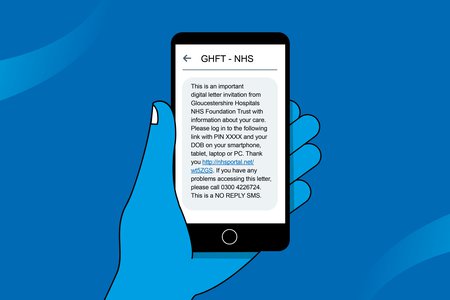
Patients on a waiting list at Gloucestershire Royal or Cheltenham General Hospitals are being contacted via text message or postal letter as part of our work to reduce the delays caused by the pandemic.
by Allysun Gore
This page provides you with basic information about vaginal vault prolapse and how it is repaired with a procedure called pelvic floor repair and sacrospinous fixation. Sacrospinous fixation is a vaginal procedure performed for women who have developed vaginal vault prolapse after a hysterectomy.
This page provides information for a person and their carer, family or friend who has suffered an injury to their throat. It is possible to have a serious injury without visible signs, meaning a medical assessment should be given.
An ultrasound scan is a test that uses high frequency sound waves to build a picture of your baby in the womb. Ultrasound scans are very safe and can be carried out at any stage of pregnancy.
This page gives you information on care following banding of piles (haemorrhoids).
If you look after someone of any age and provide unpaid support to family or friends who could not manage without your help, then you are a carer.
This page explains what to expect when your child has a general anaesthetic for a Computerised Tomography (CT) or a Magnetic Resonance Image (MRI) scan. A CT scan uses X-rays to create detailed images (pictures) of the inside of the body.
This page gives you information about having a Computed Tomography (CT) guided bone biopsy. It explains how the procedure is carried out and some of the possible complications.
Where to turn if you’re struggling with becoming a parent
This page gives you information about spiking, how it can affect you and what you should do if you think you have been spiked.
You have been advised to have a gastroscopy, which you may also have heard being called an endoscopy or OGD (meaning an oesophageal-gastro-duodenoscopy). A gastroscopy will help us to investigate the cause of your symptoms. It is important that you read this page before your appointment so that you understand what will happen during this procedure and the preparation involved.
This page gives you information about having an operation on your leg to bypass a narrowing or blockage in a blood vessel. This information answers some of the commonly asked questions with regard to hospital admission, the operation and discharge home.
The following exercises and advice will help you to get back in shape after you have had your baby. The exercises are also suitable for all deliveries. Remember to start gently and progress slowly.
You have been advised to have a therapeutic gastroscopy which provides treatment carried out via an endoscope. A gastroscopy may also be referred to as an endoscopy or OGD (meaning an oesophageal-gastro-duodenoscopy).
As part of Black History Month in October this year, we are supporting a project to showcase the stories of nursing staff from different ethnic minority backgrounds across the Trust
This page gives you information about having a Computed Tomography (CT) guided abdominal or pelvic biopsy. It explains how the procedure is carried out and some of the possible complications.