We use cookies to provide you with a better service. Carry on browsing if you’re happy with this or read more about our cookie policy and privacy policy.
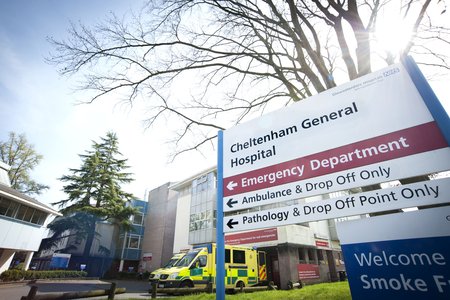
Changes to Cheltenham A&E during BMA Industrial Action 17 - 22 December
This page gives you information about uterine prolapse and laparoscopic hysteropexy (also known as sacrohysteropexy). This procedure is performed for women who wish to have uterine preservation surgery for their prolapse.
This page gives you information about your planned contrast echocardiogram.
The Gloucestershire health system undertook public consultation in 2020 and further engagement between 2022 and 2023 on shaping the future of our hospital services.
Due to essential works to replace hot water pipes, hot water will be unavailable throughout the main atrium block at Gloucestershire Royal Hospital, including the Children’s Centre, from 7:30am to 9pm on Sunday 29 September.
Department of microbiology.
Putting you in control of your follow-up care This page provides you with information about Patient Initiated Follow-Up appointments or PIFU for short, at Gloucestershire Hospitals NHS Foundation Trust. It explains what PIFU appointments are and how they work.
The information on this page will help you to safely give yourself the denosumab treatment by subcutaneous injection (an injection under the skin).
This page describes the laparoscopic (keyhole) operation to treat acid reflux and hiatus hernia. It explains the risks and benefits of surgery and the likely after effects. Dietary advice will be available from the ward before you are discharged.
This page gives you information about Photodynamic Therapy (PDT) for the age-related eye conditions macular degeneration and Central Serous Chorioretinopathy (CSCR). The aim of this page is to explain what to expect at all stages of the treatment and to answer some of the commonly asked questions.
The information given here is intended for use by healthcare professionals. Please see Lab Tests Online-UK for more general advice, links and background.
Patients come to Woodmancote ward for specialist care following a stroke. This part of our stroke unit focuses on the rehabilitation phase of stroke care and HASU at Gloucestershire Royal Hospital specialises in the acute phase.
You have been suggested this page because we want to measure the level of kidney function of your child/young person. This page gives you information about the glomerular filtration rate (IGFR) test that is used to do this and what to expect. At Gloucestershire Hospital NHS Foundation Trust we use iohexal to measure the IGFR of the kidneys to show us how well they are working.
It has been agreed that the provision of X-ray services in Gloucestershire will be revised on an interim basis to ensure that the most specialist services can continue to be provided safely. The temporary changes are a response to the high levels of radiographer vacancies being experienced in Gloucestershire.
The Gloucestershire Liver Unit (GLU) provides inpatient and outpatient care across two main hospital sites in Cheltenham and Gloucester. It has an active and growing clinical research programme in association with the NIHR.
Visiting times are: 3pm – 4.30pm and 6pm – 8pm
The Silver course consists of two half days (face to face), followed by three online modules, with the aim of developing improvement teams and working through the initial stages of their improvement initiatives.
This page gives you information about having a nerve root injection and the risks involved.
C-reactive protein (CRP) is a non-specific marker of infection and inflammation and is a more sensitive, rapidly responding indicator than ESR or viscosity.
This page gives you information about having a Computed Tomography (CT) guided bone biopsy. It explains how the procedure is carried out and some of the possible complications.