We use cookies to provide you with a better service. Carry on browsing if you’re happy with this or read more about our cookie policy and privacy policy.
Deficiency of the enzyme alpha-galactosidase, results in Fabry's disease, an X-linked, recessive, lysosomal storage disease, also known as Anderson-Fabry disease.
Anyone can be affected by pelvic health problems during or after pregnancy
This page gives you information about having a Mannitol Challenge Test (Osmohale®), including the preparation needed.
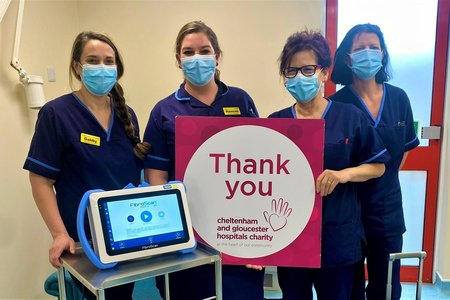
A Fibro Scanner is a type of ultrasound that is used to assess liver fibrosis in a non-invasive way. The equipment can help to provide a prompt diagnosis, which is especially important as 90% of liver disease is reversible if detected early. This also enables the hepatology team to organise a treatment plan as soon as possible for patients. The Fibroscan procedure is quick and painless, and can also help in emergency situations by providing accurate readings of liver damage in less than 15 minutes.
This page gives you information about under-breast soreness (intertrigo) including how the condition can be treated and managed.
This page provides information about performing Intermittent Self-Catheterisation (ISC).
This page provides information for patients being offered trabeculectomy for the treatment of glaucoma.
This page will give you information about having hernia surgery. It also answers some of the commonly asked questions and outlines some of the risks and possible complications linked with hernia surgery.
This page will help you to understand more about your surgery. It will also give you tips on how you can help your recovery after your back operation. Irritation or pressure (compression) of one or more of the nerves in your back causes pain in your back or legs. You may need to have surgery if the pain is not easing. Before the decision is made to have surgery, you may have several tests such as an MRI (Magnetic Resonance Imaging) scan, a CT (Computerised Tomography) scan or X-rays. This is for your doctor to be sure of the diagnosis and to see at which level in the back the nerve is being compressed.
COVID-19 is an infectious disease caused by a newly discovered coronavirus strain that first emerged in China in December 2019. In humans, coronaviruses are known to cause respiratory infections ranging from the common cold to more severe disease.
Dr Napier initially read law at the London School of Economics. He studied post-graduate medicine at the University of Southampton and completed his gastroenterology/hepatology training in the Bristol/Severn region. He has an interest in hepatology.
We will keep this notice updated to show the things we do with your personal data. We will never sell your personal data, or share it with other organisations we work with.
This page provides information for a person and their carer, family or friend who has suffered an injury to their throat. It is possible to have a serious injury without visible signs, meaning a medical assessment should be given.
Putting you in control of your follow-up care This page provides you with information about Patient Initiated Follow-Up appointments or PIFU for short, at Gloucestershire Hospitals NHS Foundation Trust. It explains what PIFU appointments are and how they work.
This page explains why we use eye drops for some visits to the Eye Clinic. This page also gives instructions on how to use them.
You are on the waiting list to have a diagnostic laparoscopy. This page gives you information about the laparoscopy and what to expect during and after the procedure.
This page gives you information about what you can expect when you have surgery at one of our hospitals and how to prepare for your surgery. If you need an interpreter or information in a different language, please phone the number on your admission letter.
Last night was a roaring success after an auction of lion sculptures raised nearly quarter of a million pounds for our new state-of-the-art cancer centre.
The information on this page will help to answer some of the questions you may have about the removal of your fibroid. Your consultant has arranged for you to have your fibroid removed hysteroscopically (removed from the inside of the womb). You will need a general anaesthetic so that you are asleep for this procedure. You should only be in hospital for the day.